Krieger and Krieger B
Print
Krieger and Krieger B
1972
Screenprint
196/250
Image: 10 11/16 × 23 1/4 in. (27.2 × 59 cm)
Paper: 22 × 28 in. (55.9 × 71.1 cm)
Gift of ITEK Corporation
1973.0053.0004
Inscriptions Signed, dated, and editioned in pencil on recto, BC: H.C. 196/250 L.Gittleman 1972
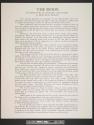
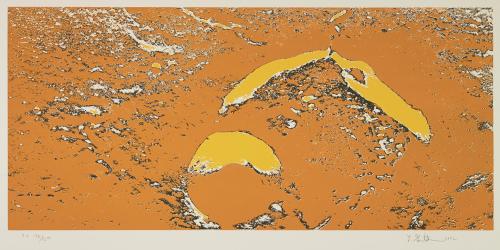
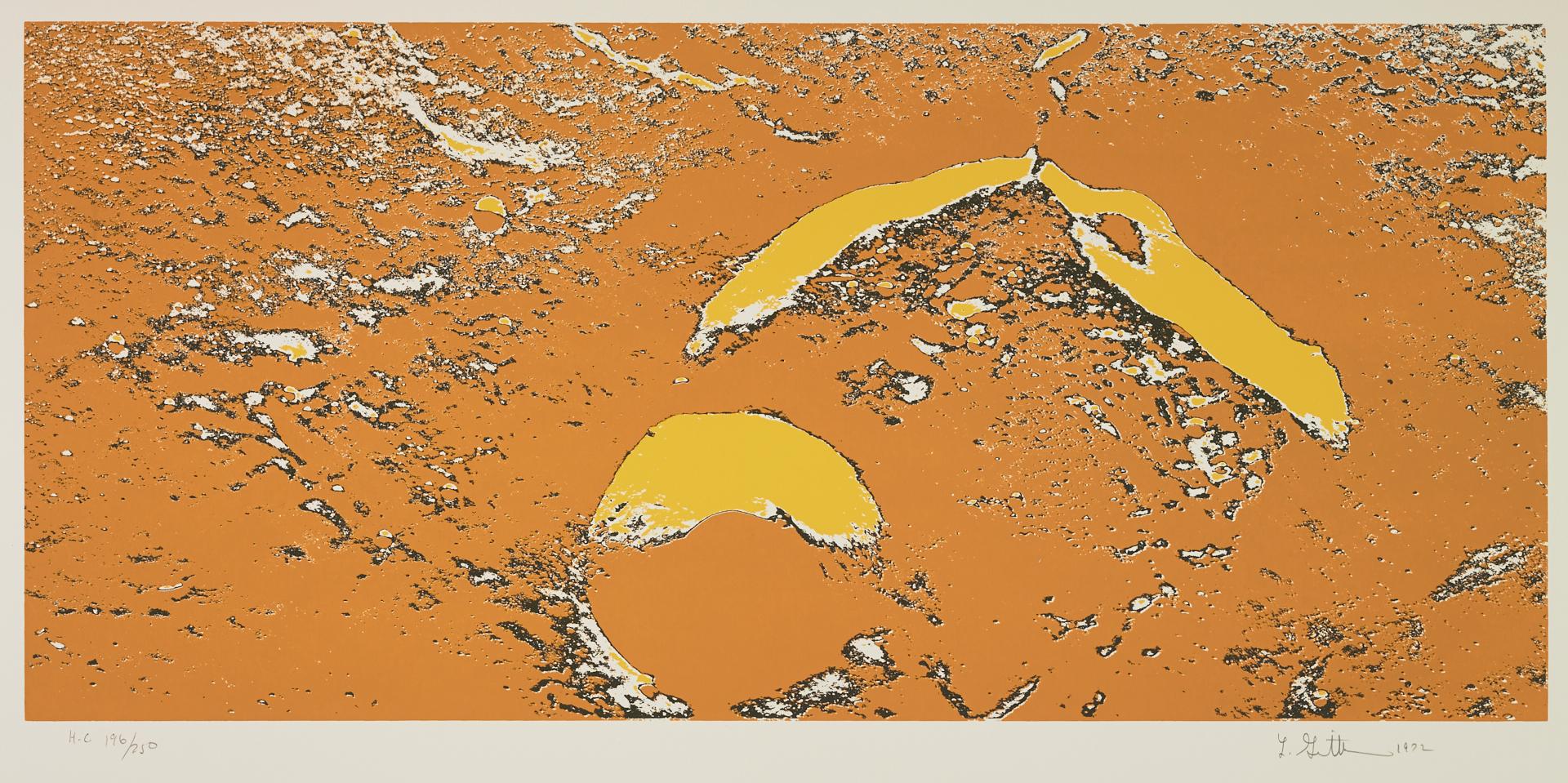
Printed on separate text page, TC: KRIEGER AND KRIEGER B, Oceanus Procellarum (Ocean of Storms), \ 30°N, 45°W. The larger and older main crater is 15 miles in diameter and \ 3,800 feet deep with features closely resembling the caldera which contains \ Crater Lake in Oregon. The smaller and younger crater is six miles in diameter \ and much deeper than the main crater. There is reason to suspect that Krieger's \ two craters may have been formed by separate eruptions from the same source. \ An interesting feature of Krieger is the rille which originates near the \ base of the smaller crater; breaks the west wall of the main crater and cuts \ through the surrounding mare floor. In this photo, the sun was in the east \ and brightly illuminated the west walls of the craters. These walls are shown \ as bright yellow areas in the serigraph. \ The craters were named for Karl A. Krieger, 1832-1896, a German astro- \ nomical observer who contributed to a noted atlas of the sky entitled Bonner \ Durchmusterung.
Printed on separate text page, TC: KRIEGER AND KRIEGER B, Oceanus Procellarum (Ocean of Storms), \ 30°N, 45°W. The larger and older main crater is 15 miles in diameter and \ 3,800 feet deep with features closely resembling the caldera which contains \ Crater Lake in Oregon. The smaller and younger crater is six miles in diameter \ and much deeper than the main crater. There is reason to suspect that Krieger's \ two craters may have been formed by separate eruptions from the same source. \ An interesting feature of Krieger is the rille which originates near the \ base of the smaller crater; breaks the west wall of the main crater and cuts \ through the surrounding mare floor. In this photo, the sun was in the east \ and brightly illuminated the west walls of the craters. These walls are shown \ as bright yellow areas in the serigraph. \ The craters were named for Karl A. Krieger, 1832-1896, a German astro- \ nomical observer who contributed to a noted atlas of the sky entitled Bonner \ Durchmusterung.
PortfolioItem