Saturn and its Rings
Photograph
Saturn and its Rings
November 16, 1980
Chromogenic development print
Image: 7 5/8 × 9 5/8 in. (19.4 × 24.5 cm)
Paper: 8 × 10 1/4 in. (20.3 × 26 cm)
Matted: 14 × 16 15/16 × 1/8 in. (35.5 × 43 × 0.3 cm)
Gift of NASA
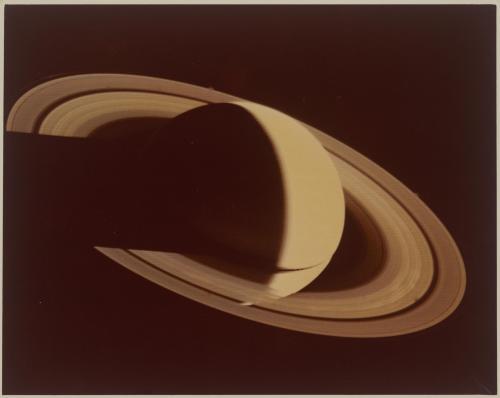
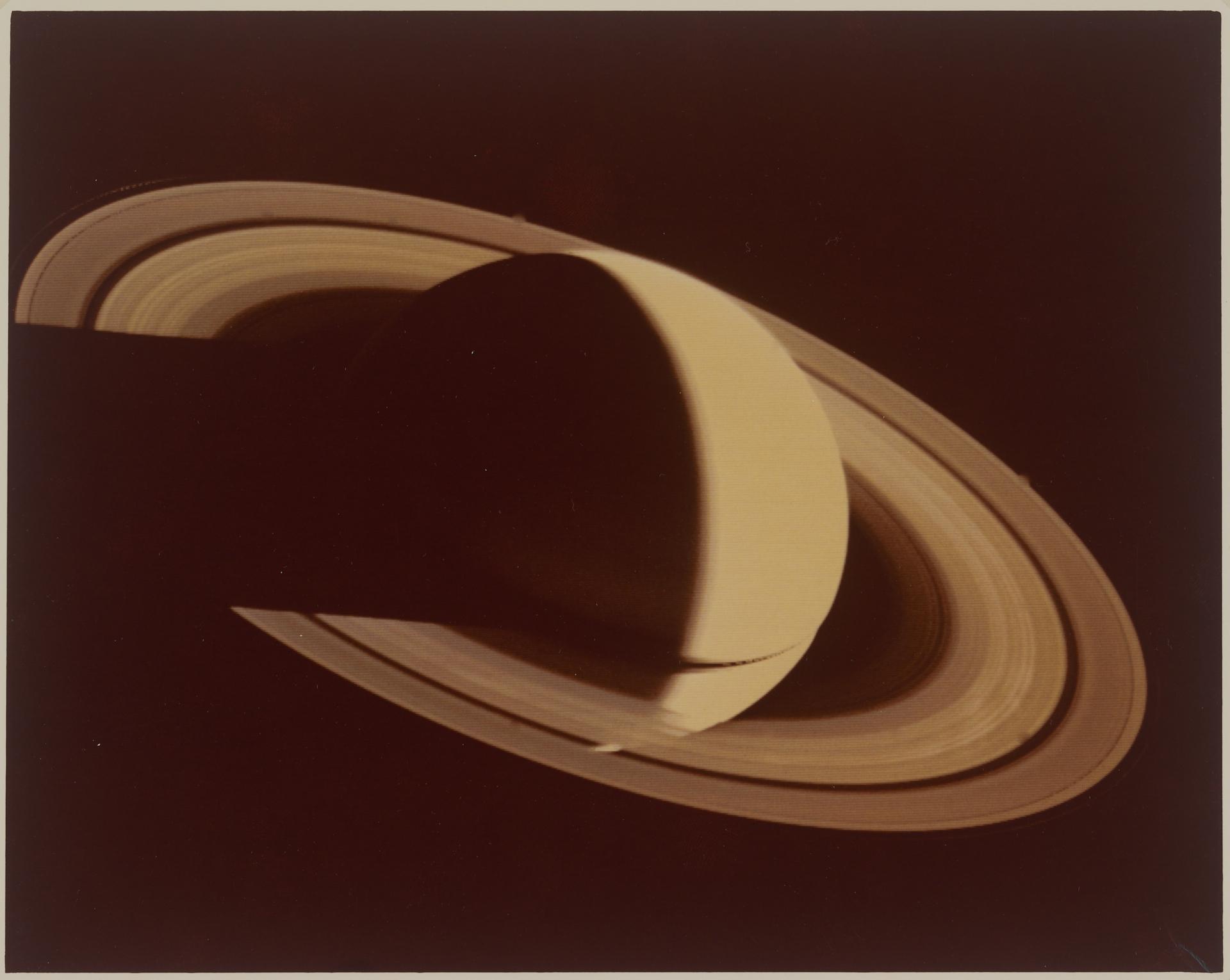
Inscriptions verso (applied label, typed): PUBLIC INFORMATION OFFICE/JET PROPULSION LABORATORY/CALIFORNIA INSTITUTE OF TECHNOLOGY/NATIONAL AERONAUTICS AND SPACE ADMINISTRATION/PASADENA, CALIFORNIA, 91109. TELEPHONE: (213) 354-5011/PHOTO CAPTION (TOP) P-23254/ S-1-62/ Dec. 3, 1980/Voyager 1 looked back at Saturn on Nov. 16, 1980, four days/ after the spacecraft flew past the planet, to observe the/ appearance of Saturn and its rings from this unique perspective./ A few of the spokelike ring features discovered by Voyager/ appear in the rings as bright patches in this image, taken/ at a distance of 5.3 million kilometers (3.3 million miles)/ from the planet. Saturn's shadow falls upon the rings, and/ the bright Saturn crescent is seen through all but the/ densest portion of the rings. From Saturn, Voyager 1 is on/ a trajectory taking the spacecraft out of the ecliptic plane,/ away from the Sun and eventually out of the solar system (by/ about 1990). Although its mission to Jupiter and Saturn is/ nearly over (the Saturn encounter ends Dec. 18, 1980), Voyager/ 1 will be tracked by the Deep Space Network as far as possible/ in an effort to determine where the influence of the Sun ends/ and interstellar space begins. Voyager 1's flight path through/ interstellar space is in the direction of the constellation/ Ophiuchus. Voyager 2 will reach Saturn on August 25, 1981,/ and is targeted to encounter Uranus in 1986 and possibly/ Neptune in 1989. The Voyager project is managed for NASA by/ the Jet Propulsion Laboratory, Pasadena, California./ #####