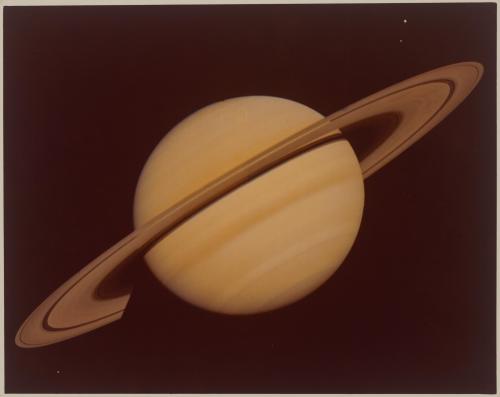
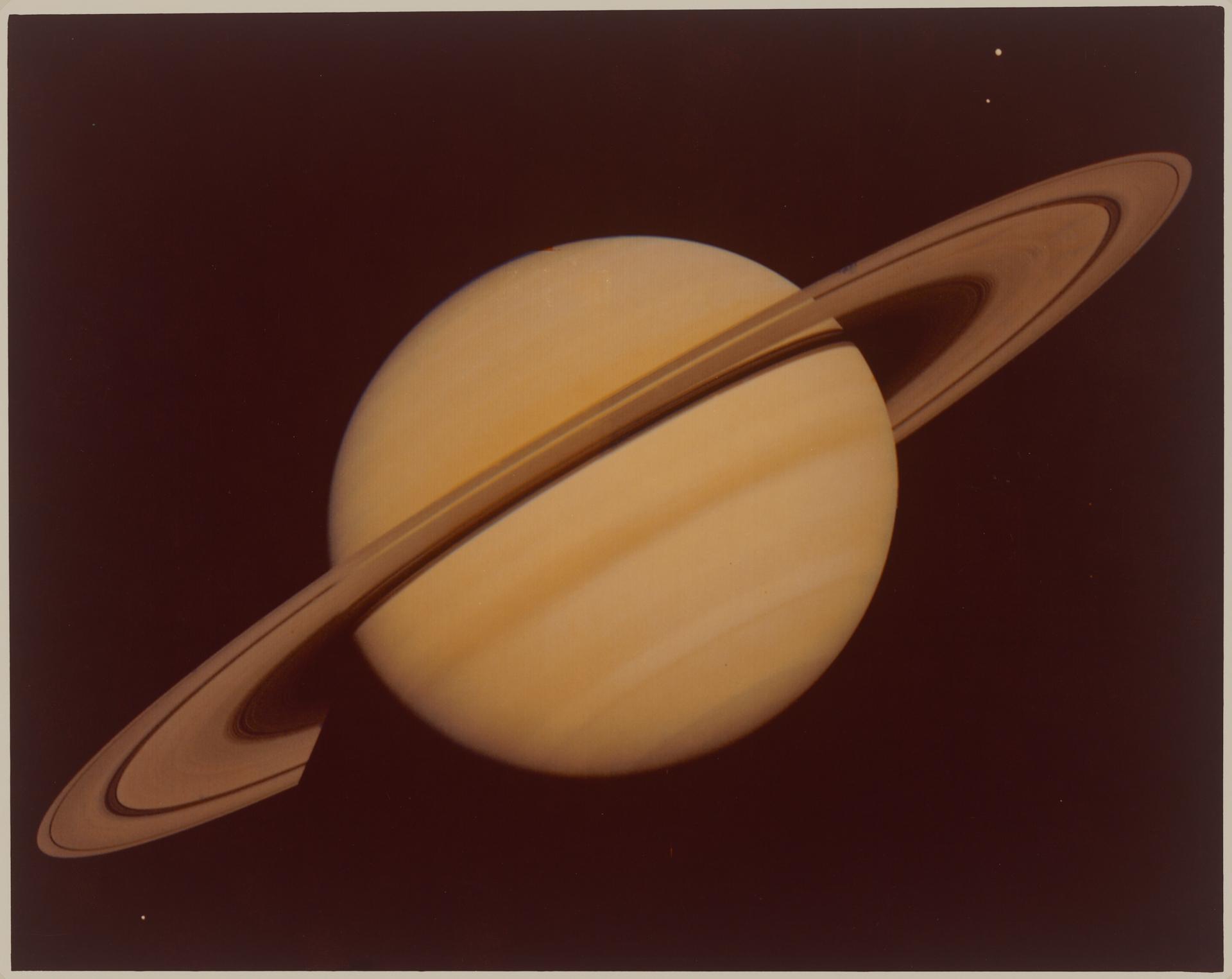
Saturn and its satellites Tethys, Enceladus and Mimas
Photograph
Saturn and its satellites Tethys, Enceladus and Mimas
October 30, 1980
Chromogenic development print
Image: 7 5/8 × 9 5/8 in. (19.3 × 24.4 cm)
Paper: 8 × 10 1/8 in. (20.3 × 25.7 cm)
Matted: 14 × 16 15/16 × 1/8 in. (35.5 × 43 × 0.3 cm)
Gift of NASA
Inscriptions verso (applied label, typed): PUBLIC INFORMATION OFFICE/JET PROPULSION LABORATORY/CALIFORNIA INSTITUTE OF TECHNOLOGY/NATIONAL AERONAUTICS AND SPACE ADMINISTRATION/PASADENA, CALIFORNIA, 91109. TELEPHONE: (213) 354-5011/PHOTO CAPTION (TOP) P-23077 C/BW/ S-1-26/ Nov. 10, 1980/
Saturn and its satellites Tethys (outer left), Enceladus (inner left)/ and Mimas (right of rings) are seen in this mosaic of images/ taken by NASA's Voyager 1 on Oct. 30, 1980 from a distance of/ 18 million kilometers (11 million miles). The soft, velvety/ appearance of the low-contrast banded structure and increased/ reflection of blue light near the perimeter of the Saturn disk/ are due to scattering by a haze layer above the planet's cloud/ deck. Features larger than 350 kilometers (220 miles) are visible./ The projected width of the rings at the center of the disk is/ 10,000 kilometers (6,000 miles), which provides a scale for/ estimating feature sizes on the image.
Saturn and its satellites Tethys (outer left), Enceladus (inner left)/ and Mimas (right of rings) are seen in this mosaic of images/ taken by NASA's Voyager 1 on Oct. 30, 1980 from a distance of/ 18 million kilometers (11 million miles). The soft, velvety/ appearance of the low-contrast banded structure and increased/ reflection of blue light near the perimeter of the Saturn disk/ are due to scattering by a haze layer above the planet's cloud/ deck. Features larger than 350 kilometers (220 miles) are visible./ The projected width of the rings at the center of the disk is/ 10,000 kilometers (6,000 miles), which provides a scale for/ estimating feature sizes on the image.