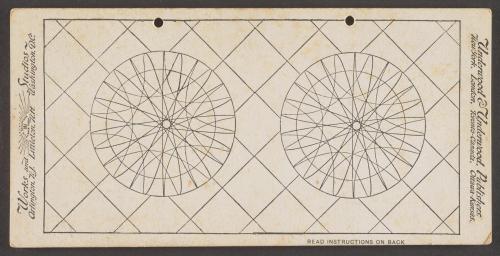
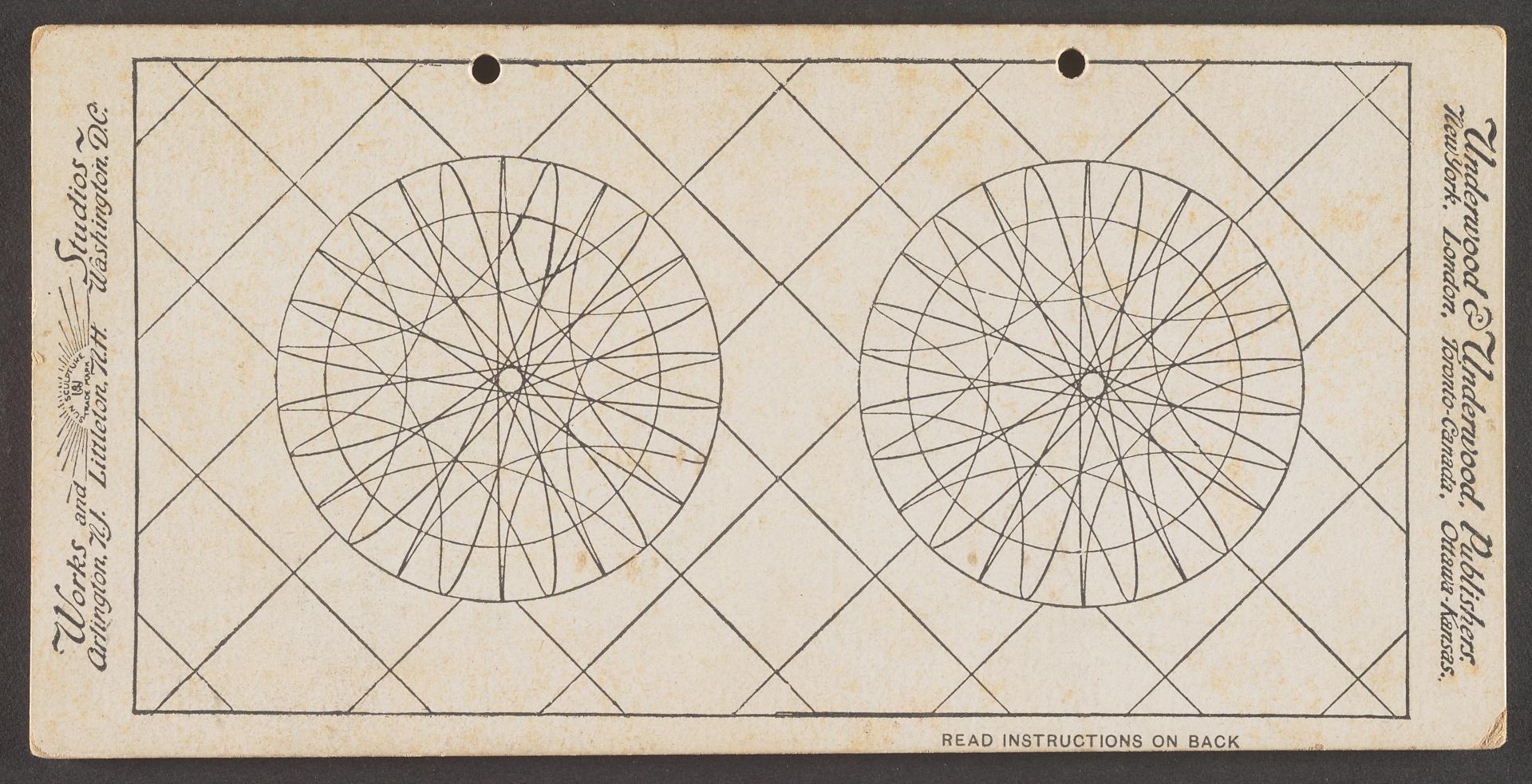
[Salesman's demonstration card with a line drawn diagram]
Print
Underwood & Underwood
American, 1880–1931
[Salesman's demonstration card with a line drawn diagram]
1902
Letterpress print
Overall: 3 7/16 × 6 15/16 in. (8.8 × 17.7 cm)
Purchase, ex-collection Fred S. Lightfoot
Inscriptions Printed in black on recto, L: Works and Studios \ Arlingont, N.J. Littleton, N.H. Washington, D.C.
Printed in black on recto, R: Underwood & Underwood. Publishers. \ New York. London Toronto-Canada. Ottawa-Kansas.
Printed in black on recto, BR: READ INSTRUCTIONS ON BACK
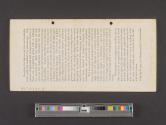
Printed in black on verso, OA: Examine the figures on this card carefully \ both with and without the stereoscope. Can \ you see foreground and background; that is, is \ there any perspective either with or without \ the instrument? Both the diagrams on this \ card are left diagrams (intended for the left \ eye only), and that is the reason the stereoscope \ has no effect. That is why there is no binocular \ (two eye) perspective. Now, without remov- \ ing the long card, insert the short card in such \ a manner as to cover accurately the right hand \ figure of the long one. The result is to place \ the diagrams intended for the right and left \ eyes respectively in correct relative positions. \ When you look in the stereoscope observe two \ things carefully: First, is the small hole in the \ globular figure toward you or away from you? \ Second, are the straight diagonal lines before \ the globe or behind it? Now, slide the short \ card to the left side of the long one, and, when \ you have focused properly through the stereoscope, ask yourself the same questions. \ You have seen, first, that without the glass \ these figures give no perspective; while if the \ right and left figures are properly arranged \ under the glass the result is a spherical figure \ with real depth or thickness. Second, you \ have seen that a transposition of the figures, \ left to right and right to left, has the result of \ changing foreground to background, and vice \ versa. \ The purpose of the figures is to show, first, \ that binocular perspective may give of itself \ perfect space for the eyes; second, that it may \ not only be sufficient, but all sufficient, as the apparent position of objects with respect to us \ may be completely reversed by seeing with / he [sic] right eye what was intended for the left, / and vice versa.\ Copyright 1902, by Underwood & Underwood.
Stamped in gray on verso, RC: A.F. Onderdonk [?]
Printed in black on recto, R: Underwood & Underwood. Publishers. \ New York. London Toronto-Canada. Ottawa-Kansas.
Printed in black on recto, BR: READ INSTRUCTIONS ON BACK
Printed in black on verso, OA: Examine the figures on this card carefully \ both with and without the stereoscope. Can \ you see foreground and background; that is, is \ there any perspective either with or without \ the instrument? Both the diagrams on this \ card are left diagrams (intended for the left \ eye only), and that is the reason the stereoscope \ has no effect. That is why there is no binocular \ (two eye) perspective. Now, without remov- \ ing the long card, insert the short card in such \ a manner as to cover accurately the right hand \ figure of the long one. The result is to place \ the diagrams intended for the right and left \ eyes respectively in correct relative positions. \ When you look in the stereoscope observe two \ things carefully: First, is the small hole in the \ globular figure toward you or away from you? \ Second, are the straight diagonal lines before \ the globe or behind it? Now, slide the short \ card to the left side of the long one, and, when \ you have focused properly through the stereoscope, ask yourself the same questions. \ You have seen, first, that without the glass \ these figures give no perspective; while if the \ right and left figures are properly arranged \ under the glass the result is a spherical figure \ with real depth or thickness. Second, you \ have seen that a transposition of the figures, \ left to right and right to left, has the result of \ changing foreground to background, and vice \ versa. \ The purpose of the figures is to show, first, \ that binocular perspective may give of itself \ perfect space for the eyes; second, that it may \ not only be sufficient, but all sufficient, as the apparent position of objects with respect to us \ may be completely reversed by seeing with / he [sic] right eye what was intended for the left, / and vice versa.\ Copyright 1902, by Underwood & Underwood.
Stamped in gray on verso, RC: A.F. Onderdonk [?]