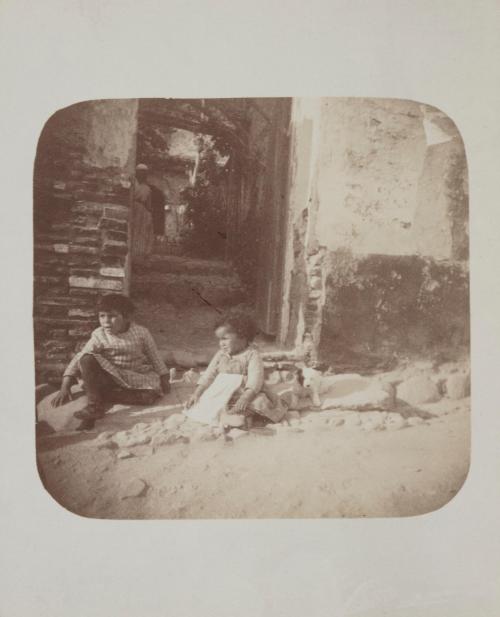
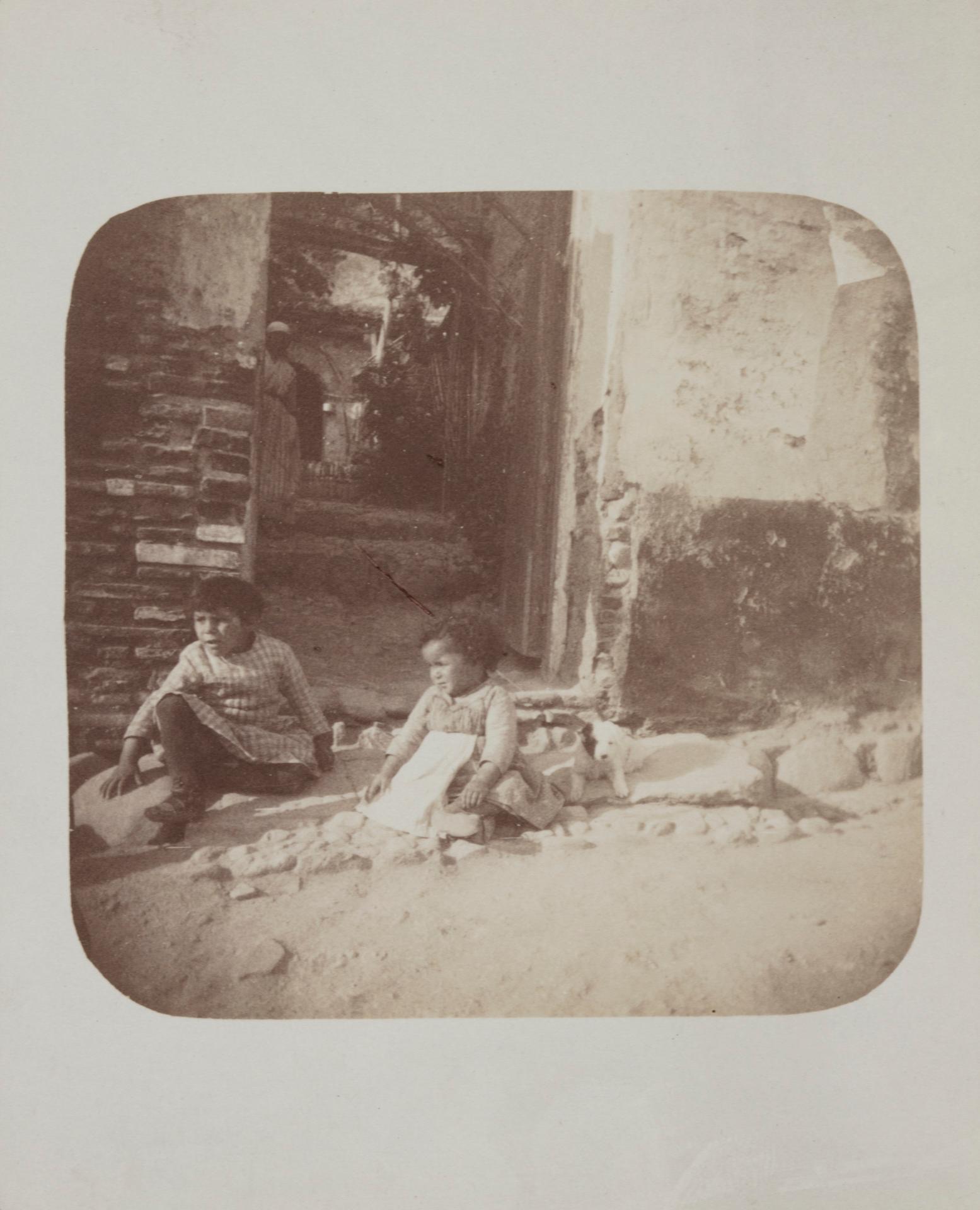
[Gypsy children, Granada]

Photograph
[Gypsy children, Granada]
June 3, 1891
Gelatin silver print
Image: 3 3/16 × 3 5/16 in. (8.1 × 8.4 cm)
Paper: 4 13/16 × 3 15/16 in. (12.3 × 10 cm)
Mount: 5 1/4 × 4 3/16 in. (13.3 × 10.7 cm)
Gift of an anonymous donor
1978.1306.0293
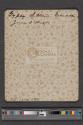
Inscriptions Inscribed in black ink on verso (Emily Sibley Watson's hand), TC: Gypsy children. Granada - \ June 3rd, 1891
Printed in brown ink on verso, C: [Kodak label]
Printed in brown ink on verso, C: [Kodak label]
TextThe Eastman Dry Plate & Film Company (later named Eastman Kodak Company) released the first “point-and-shoot” camera in 1888, starting the trend of capturing everyday life on film. Within a year, the company released the improved No. 1 and No. 2 models. These first two Kodak cameras created circular negatives, as seen in the homemade cyanotypes attributed to Emily Sibley Watson. Watson was a Rochester native, an early amateur snapshot photographer, and founder of the city’s Memorial Art Gallery. By 1891, she was using a Kodak No. 3 camera—the first Kodak model to produce rectangular negatives—to take photographs while on her honeymoon to Spain and Morocco. Snapshot photography and photofinishing services simplified the production of photographs. The practice that was previously labor intensive and expensive became more accessible to consumers.