Mama and Junior
Photograph
Mama and Junior
July 22, 1945
Gelatin silver print
Paper: 8 × 10 in. (20.3 × 25.4 cm)
Gift of Joanna T. Steichen, ex-collection Edward Steichen
1974.0025.0024
Inscriptions printed in negative on recto BRC: USMC and emblem
printed in ink on verso: DO NOT RELEASE PRIOR TO JULY 22, 1945/
EYES OF THE ARTILLERY/
Squadrons of Marine grasshopper planes fly observation/ and fire control missions behind enemy lines in the Pacific/ war zone. During the Okinawa campaign, the tiny ships kept/ a vigil over the capital city of Naha directing artillery/ fire, photographing objectives and spotting remaining points/ of enemy resistance along the front lines. Lacking fire power/ and armor the "Flying Jeeps" bear scars of ack ack and small/ arms fire. To alleviate the feeling of being the bulls-eye,/ grasshopper pilots occaisonally drop hand grenades, fire/ pistols and tommy guns at enemy positions and even mounted/ bazookas on the wing struts of the planes./
In addition to their observation duties the Lilliputian/ planes operate a shuttle service evacuating wounded from the/ battlefield to rear area aid stations; drop mail, food and/
medical supplies to the beleaguered Marines on the front lines/ and can be rigged to string five miles of communication wire/ at a speed of seventy miles per hour. Capable of lighting on/ a small strip, these planes are usually the first craft to/
land on newly-won airbases./
This series of pictures portrays the activities of a/ grasshopper unit during the Okinawa operation./
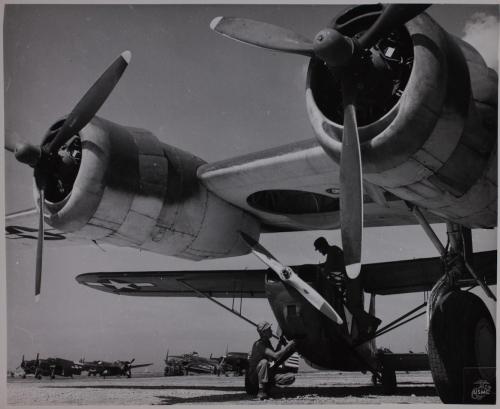
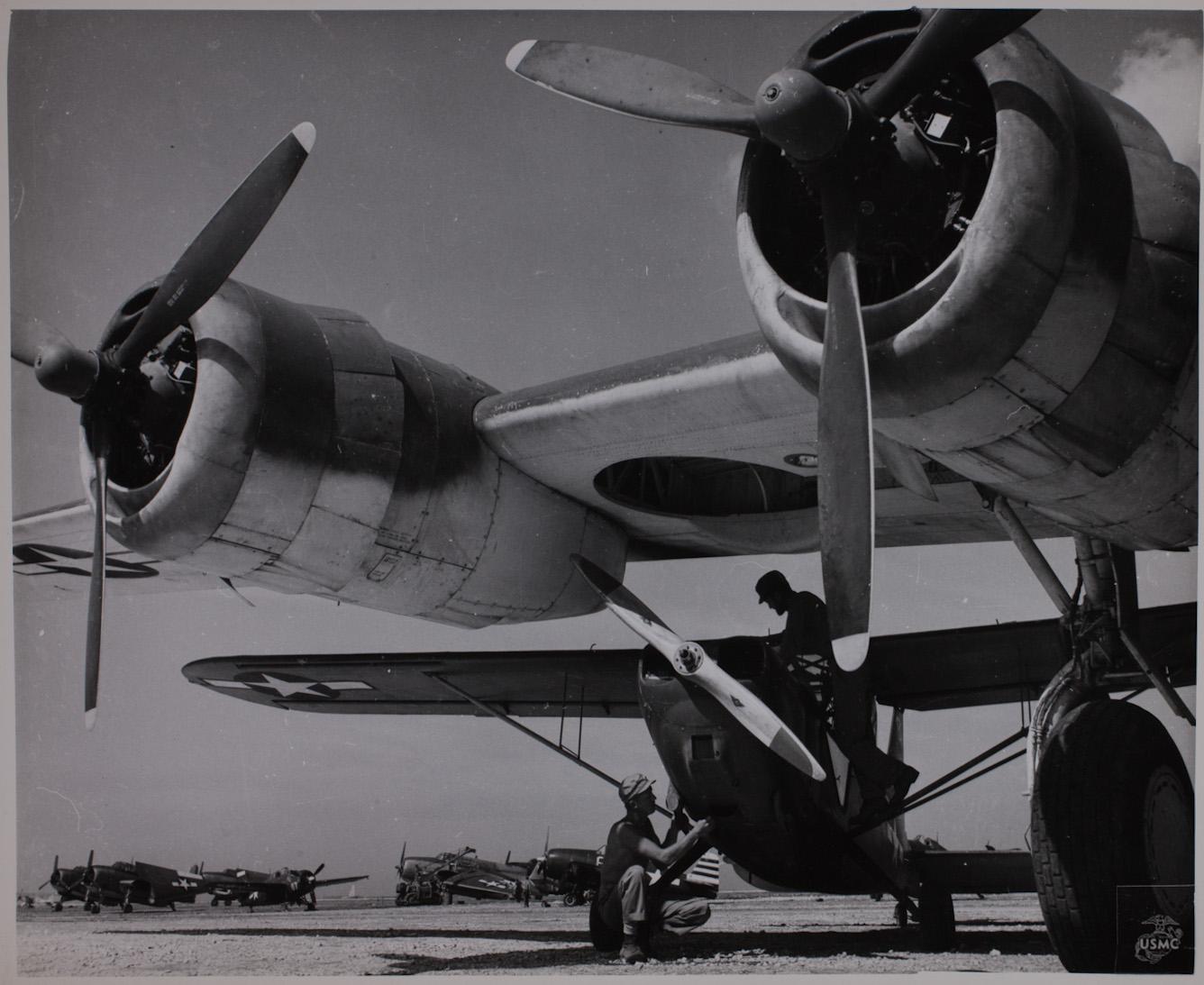
MAMA AND JUNIOR --- Nestled in the shade of a wing of a/ large patrol bomber, ground crewmen make repairs on one/ of the grasshoppers. This tiny plane was the first to/
land on Okinawa and has been operation throughout the/ campaign despite minor mishaps./
Hdqrs. No. 125,029 WATCH YOUR CREDIT LINE/
DIST LIST 1-3-4Roto OFFICIAL U.S. MARINE CORPS PHOTO/
By Lieutenant David D. Duncan./
DO NOT RELEASE PRIOR TO JULY 22, 1945/
printed in ink on verso: DO NOT RELEASE PRIOR TO JULY 22, 1945/
EYES OF THE ARTILLERY/
Squadrons of Marine grasshopper planes fly observation/ and fire control missions behind enemy lines in the Pacific/ war zone. During the Okinawa campaign, the tiny ships kept/ a vigil over the capital city of Naha directing artillery/ fire, photographing objectives and spotting remaining points/ of enemy resistance along the front lines. Lacking fire power/ and armor the "Flying Jeeps" bear scars of ack ack and small/ arms fire. To alleviate the feeling of being the bulls-eye,/ grasshopper pilots occaisonally drop hand grenades, fire/ pistols and tommy guns at enemy positions and even mounted/ bazookas on the wing struts of the planes./
In addition to their observation duties the Lilliputian/ planes operate a shuttle service evacuating wounded from the/ battlefield to rear area aid stations; drop mail, food and/
medical supplies to the beleaguered Marines on the front lines/ and can be rigged to string five miles of communication wire/ at a speed of seventy miles per hour. Capable of lighting on/ a small strip, these planes are usually the first craft to/
land on newly-won airbases./
This series of pictures portrays the activities of a/ grasshopper unit during the Okinawa operation./
MAMA AND JUNIOR --- Nestled in the shade of a wing of a/ large patrol bomber, ground crewmen make repairs on one/ of the grasshoppers. This tiny plane was the first to/
land on Okinawa and has been operation throughout the/ campaign despite minor mishaps./
Hdqrs. No. 125,029 WATCH YOUR CREDIT LINE/
DIST LIST 1-3-4Roto OFFICIAL U.S. MARINE CORPS PHOTO/
By Lieutenant David D. Duncan./
DO NOT RELEASE PRIOR TO JULY 22, 1945/