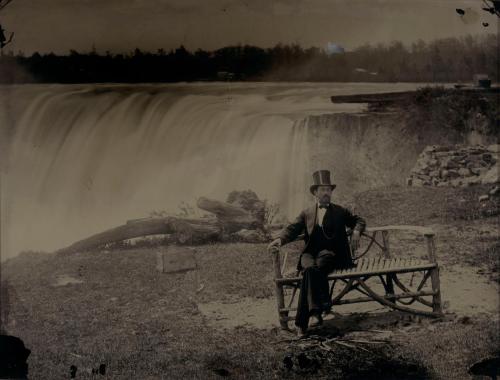
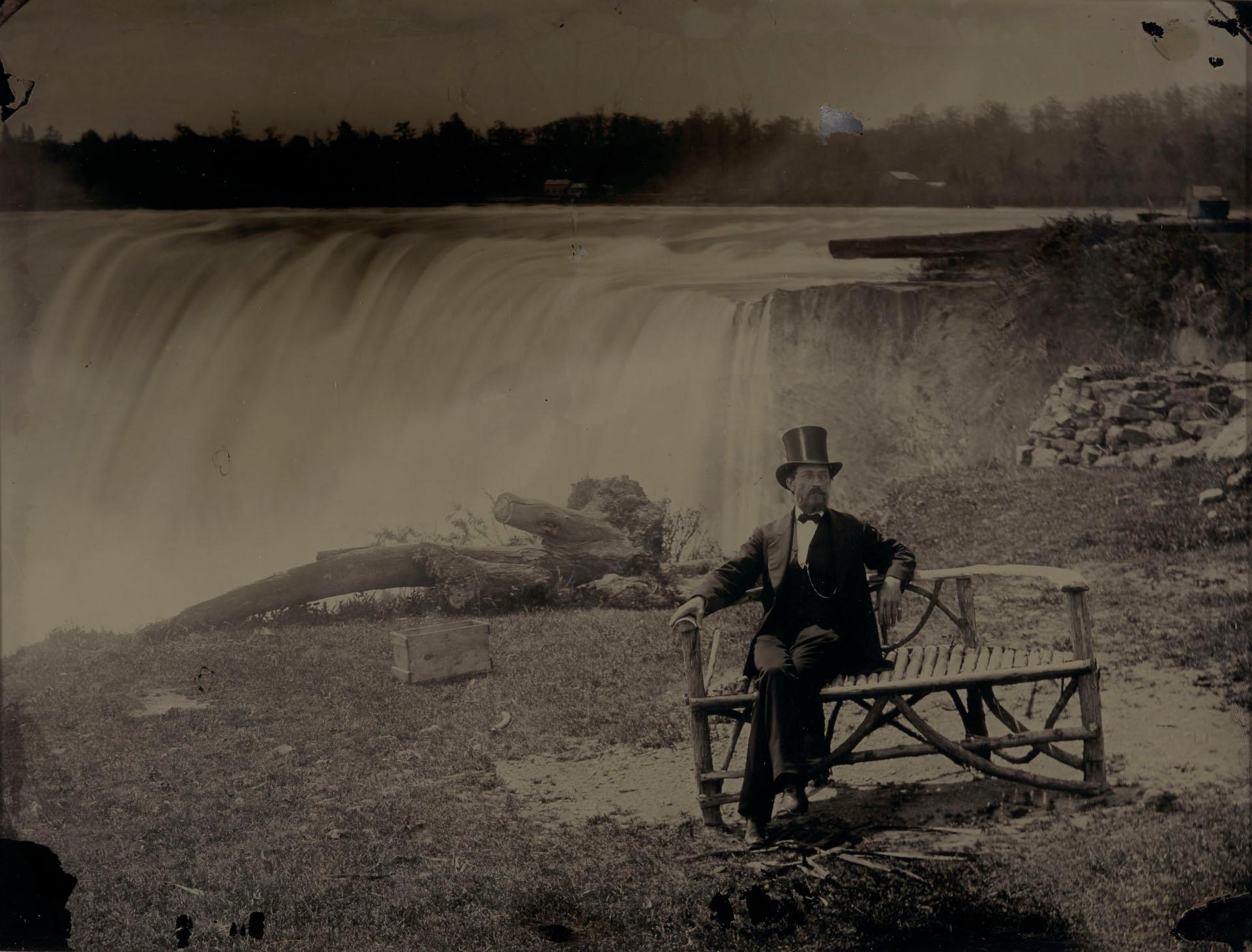
[Man at Table Rock, Niagara Falls]

Photograph
[Man at Table Rock, Niagara Falls]
April 1858
Ambrotype
Image: 6 3/16 × 8 1/8 in. (15.7 × 20.6 cm) (whole plate)
Purchase
1969.0203.0006
Inscriptions Printed on label on verso, C: DAVIS. \ PHOTOGRAPHER, \ TABLE ROCK. \ NIAGARA FALLS, C.W.
Inscribed in pencil below printed label on verso, C: No 355[?]
Inscribed in pencil on verso of board, BC: MACKAY #549 [APRIL 1858-MACKAY \ NOTEBOOK]
Entry 549 in Mackay's notebook (located in library): Fine full-plate ambrotype of Niagara Falls taken at Table Rock, April 16, 1858, by “Davis, Photographer, Table Rock Niagara Falls, C.W.” In nice criss-cross walnut frame. Traded with Mr. Philip Myers of N.J. for 8 small ambros & tintypes of Civil War soldiers which were worth about $5 or less. Large ambrotype worth about $20.
Inscribed in pencil below printed label on verso, C: No 355[?]
Inscribed in pencil on verso of board, BC: MACKAY #549 [APRIL 1858-MACKAY \ NOTEBOOK]
Entry 549 in Mackay's notebook (located in library): Fine full-plate ambrotype of Niagara Falls taken at Table Rock, April 16, 1858, by “Davis, Photographer, Table Rock Niagara Falls, C.W.” In nice criss-cross walnut frame. Traded with Mr. Philip Myers of N.J. for 8 small ambros & tintypes of Civil War soldiers which were worth about $5 or less. Large ambrotype worth about $20.
TextFirst introduced in the 1850s, tintype and ambrotype photographs enjoyed widespread popularity throughout the 1860s and ’70s. Both used the wet-plate collodion process, which involved a light sensitive liquid emulsion that was coated onto a support and quickly exposed to light before the solution dried. The primary difference between ambrotypes and tintypes were their supports: tintypes used a thin sheet of iron coated with a dark lacquer as their base, whereas ambrotypes used a sheet of glass backed with a black material. Despite the obvious difficulties involved with handling a wet emulsion within a constricted timeframe, wet collodion-based processes were attractive to photographers for their high light sensitivity, ability to record minute detail, and relative cheapness, a quality that led the tintype to be colloquially known as “the poor man’s daguerreotype” and made informal sittings such as these economically feasible.
Lisa Hostetler, Ph.D.
Curator in Charge, Department of Photography
Label for A History of Photography [Rotation 1]
May 9–September 28, 2014
Lisa Hostetler, Ph.D.
Curator in Charge, Department of Photography
Label for A History of Photography [Rotation 1]
May 9–September 28, 2014