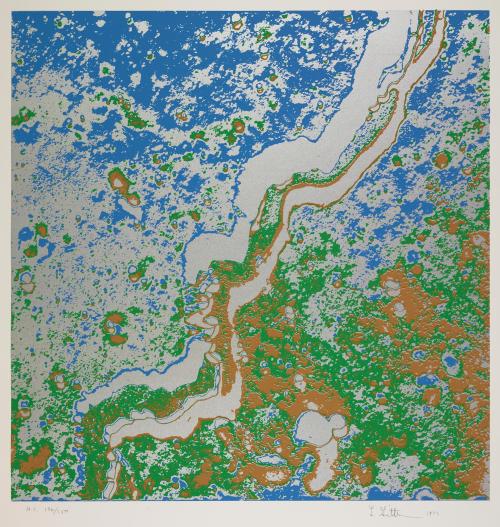
Schroeter's Valley
Print
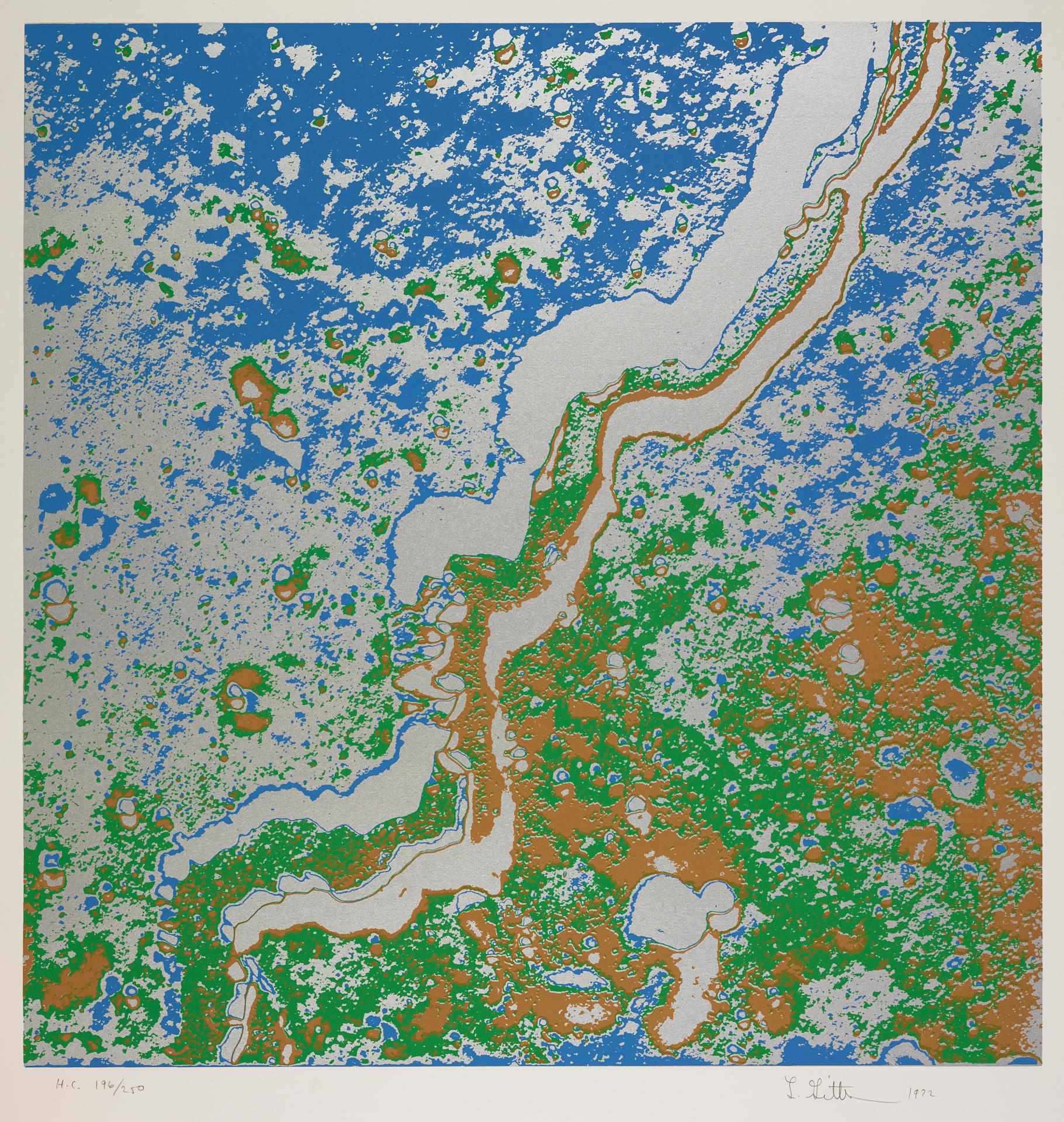
Schroeter's Valley
1972
Screenprint
196/250
Image: 17 1/2 × 17 1/8 in. (44.5 × 43.5 cm)
Paper: 28 × 22 in. (71.1 × 55.9 cm)
Gift of ITEK Corporation
1973.0053.0002
Inscriptions Signed, dated, and editioned in pencil on recto, BC: H.C. 196/250 L.Gittleman 1972
Printed on separate text page, TC: SCHROETER'S VALLEY, Oceanus Procellarum, (Ocean of Storms) \ 25°N, 50°W. This is a portion of a 150-mile-long lunar valley which is almost \ a mile deep and over a mile wide. A narrow, serpentine rille meanders through \ the valley much like a terrestrial river in flat terrain. Selenologists believe \ that the main valley was created by the downward displacement of the surface \ between two roughly parallel faults. Craters in the floor appear to be the result \ of pyroclastic venting; the valley floor is covered by a thin veneer of ash or \ cinders. A thin lava flow has partially filled the 650-foot-deep craters in the \ rille and on the plateau. \ Astronomers have periodically reported telescope sightings of unex- \ plained reddish flows or haze in the vicinity of this area and in nearby Aristarchus \ and Herodotus. These sightings are believed to indicate that volcanic venting or \ out-gassing may have taken place. \ Schroeter's Valley was the first of the valley-clefts to be detected by \ telescope. It was discovered in 1787 by J.H. Schroeter (1745-1816), a German \ who is considered to be the founder of modern selenography.
Printed on separate text page, TC: SCHROETER'S VALLEY, Oceanus Procellarum, (Ocean of Storms) \ 25°N, 50°W. This is a portion of a 150-mile-long lunar valley which is almost \ a mile deep and over a mile wide. A narrow, serpentine rille meanders through \ the valley much like a terrestrial river in flat terrain. Selenologists believe \ that the main valley was created by the downward displacement of the surface \ between two roughly parallel faults. Craters in the floor appear to be the result \ of pyroclastic venting; the valley floor is covered by a thin veneer of ash or \ cinders. A thin lava flow has partially filled the 650-foot-deep craters in the \ rille and on the plateau. \ Astronomers have periodically reported telescope sightings of unex- \ plained reddish flows or haze in the vicinity of this area and in nearby Aristarchus \ and Herodotus. These sightings are believed to indicate that volcanic venting or \ out-gassing may have taken place. \ Schroeter's Valley was the first of the valley-clefts to be detected by \ telescope. It was discovered in 1787 by J.H. Schroeter (1745-1816), a German \ who is considered to be the founder of modern selenography.
PortfolioItem