Rilles
Print
Rilles
1972
Screenprint
196/250
Image: 15 13/16 × 22 13/16 in. (40.2 × 58 cm)
Paper: 22 × 28 in. (55.9 × 71.1 cm)
Gift of ITEK Corporation
1973.0053.0005
Inscriptions Signed, dated, and editioned in pencil on recto, BC: H.C. 196/250 L.Gittleman 1972
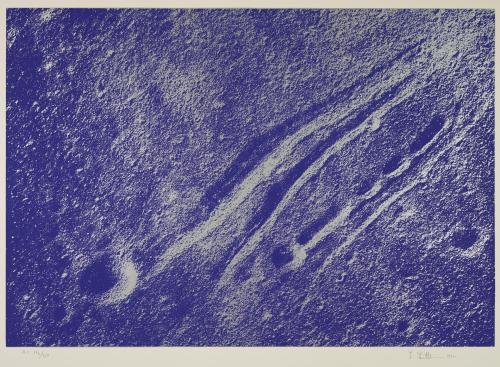
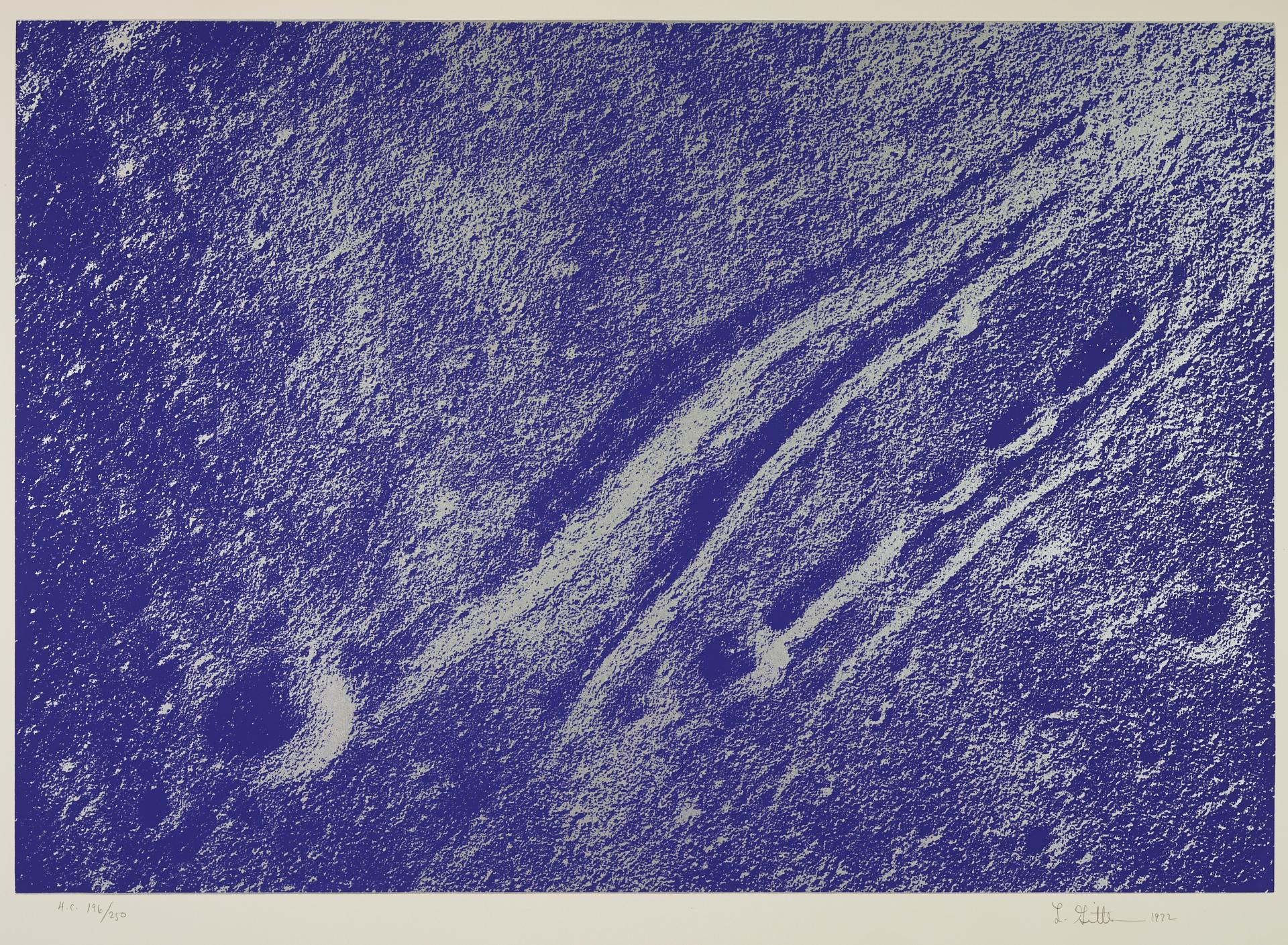
Printed on separate text page, TC: RILLES, Mare Serenitatis, (Sea of Serenity) 18°N, 27°E. This group of \ rilles is on the southeastern edge of Mare Serenitatis north of the crater Dawes. \ Two of the rilles appear to originate from small depressions or pools, a char- \ acteristic of many of the rilles found on the moon. One rille consists of a series \ of four elongated craters. \ Rilles are depressions on the lunar surface that resemble terrestrial \ valleys or canyons. They are common in some mare areas and rare in highland \ areas. Their causes have not been definitely established but scientists have \ offered several possible explanations. According to one theory they were formed \ by the action of particles carried by the flow of liquid lava or jets of gasses. \ The depressions at the end of the rilles would then indicate where the flow \ originated or was greatest. Other theories attribute the formation of rilles \ to gasses venting through fractures in the lunar surface, to the collapse of \ sub-surface lava tubes, or to cracking of the surface when large areas of liquid \ lava cooled and shrank.
Printed on separate text page, TC: RILLES, Mare Serenitatis, (Sea of Serenity) 18°N, 27°E. This group of \ rilles is on the southeastern edge of Mare Serenitatis north of the crater Dawes. \ Two of the rilles appear to originate from small depressions or pools, a char- \ acteristic of many of the rilles found on the moon. One rille consists of a series \ of four elongated craters. \ Rilles are depressions on the lunar surface that resemble terrestrial \ valleys or canyons. They are common in some mare areas and rare in highland \ areas. Their causes have not been definitely established but scientists have \ offered several possible explanations. According to one theory they were formed \ by the action of particles carried by the flow of liquid lava or jets of gasses. \ The depressions at the end of the rilles would then indicate where the flow \ originated or was greatest. Other theories attribute the formation of rilles \ to gasses venting through fractures in the lunar surface, to the collapse of \ sub-surface lava tubes, or to cracking of the surface when large areas of liquid \ lava cooled and shrank.
PortfolioItem