Vitruvius E
Print
Vitruvius E
1972
Screenprint
196/250
Image: 17 1/16 × 22 9/16 in. (43.3 × 57.3 cm)
Paper: 22 × 28 in. (55.9 × 71.1 cm)
Gift of ITEK Corporation
1973.0053.0006
Inscriptions Signed, dated, and editioned in pencil on recto, BC: H.C. 196/250 L.Gittleman 1972
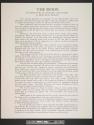
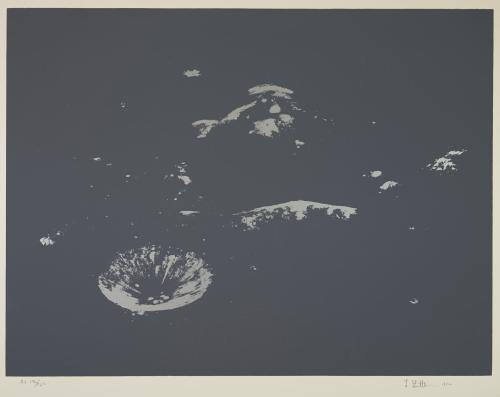
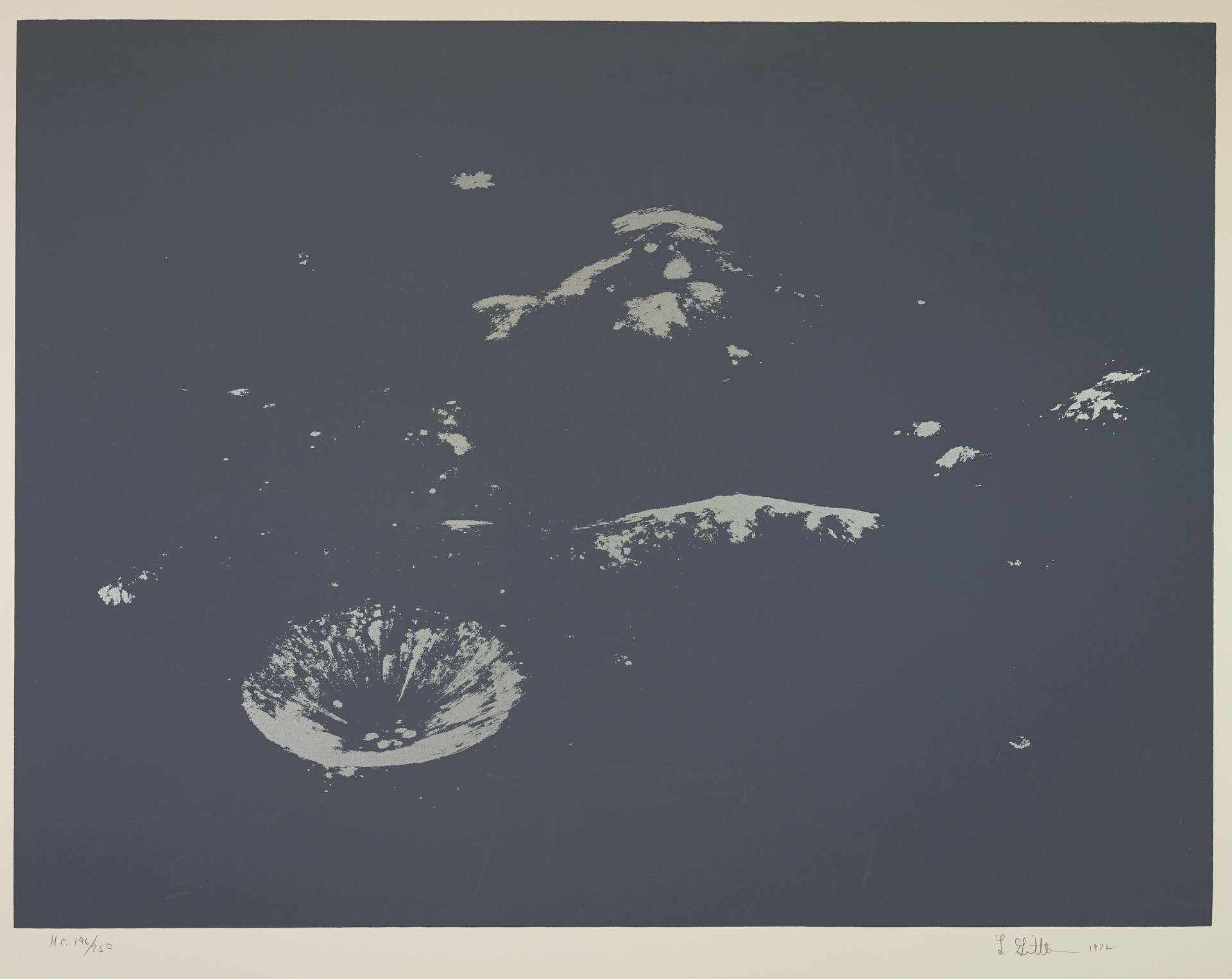
Printed on separate text page, TC: VITRUVIUS E, Mare Serenitatis, (Sea of Serenity) 20°N, 29°E. The \ crater in the foreground is Vitruvius E, one of a group named after a Roman \ writer on architecture who lived about 100 B.C. It is a small crater, about six \ miles in diameter, located in the vicinity of the larger crater Littrow in the \ Taurus mountains. \ The bright band in the background is the 8,000-foot-high peak Mount \ Argaeus. The rounded, smooth surface of the surrounding hills is typical of \ many parts of the lunar highlands. Morphological features which originally \ may have been sharp and irregular have become rounded with the passing of \ time, partly as a result of the downward movement of loosely compacted materials \ under the influence of lunar gravity, possibly aided by moonquakes and meteorite \ bombardment. The darker areas in the photograph are ash-like material, \ probably of volcanic origin. \ This area is adjacent to the Apollo 17 landing site which is located at \ 20°N, 30°E.
Printed on separate text page, TC: VITRUVIUS E, Mare Serenitatis, (Sea of Serenity) 20°N, 29°E. The \ crater in the foreground is Vitruvius E, one of a group named after a Roman \ writer on architecture who lived about 100 B.C. It is a small crater, about six \ miles in diameter, located in the vicinity of the larger crater Littrow in the \ Taurus mountains. \ The bright band in the background is the 8,000-foot-high peak Mount \ Argaeus. The rounded, smooth surface of the surrounding hills is typical of \ many parts of the lunar highlands. Morphological features which originally \ may have been sharp and irregular have become rounded with the passing of \ time, partly as a result of the downward movement of loosely compacted materials \ under the influence of lunar gravity, possibly aided by moonquakes and meteorite \ bombardment. The darker areas in the photograph are ash-like material, \ probably of volcanic origin. \ This area is adjacent to the Apollo 17 landing site which is located at \ 20°N, 30°E.
PortfolioItem