Lunar Features
Print
Lunar Features
1972
Screenprint
196/250
Image: 16 5/16 × 22 5/8 in. (41.5 × 57.5 cm)
Paper: 22 × 28 in. (55.9 × 71.1 cm)
Gift of ITEK Corporation
1973.0053.0007
Inscriptions Signed, dated, and editioned in pencil on recto, BC: H.C. 196/250 L.Gittleman 1972
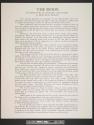
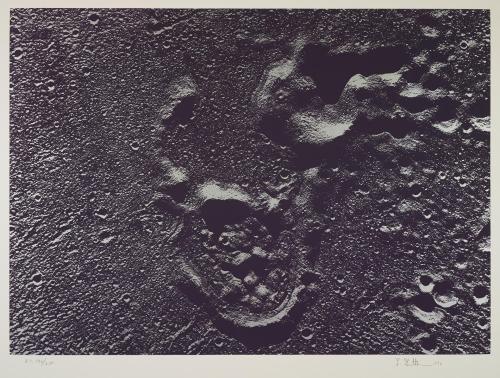
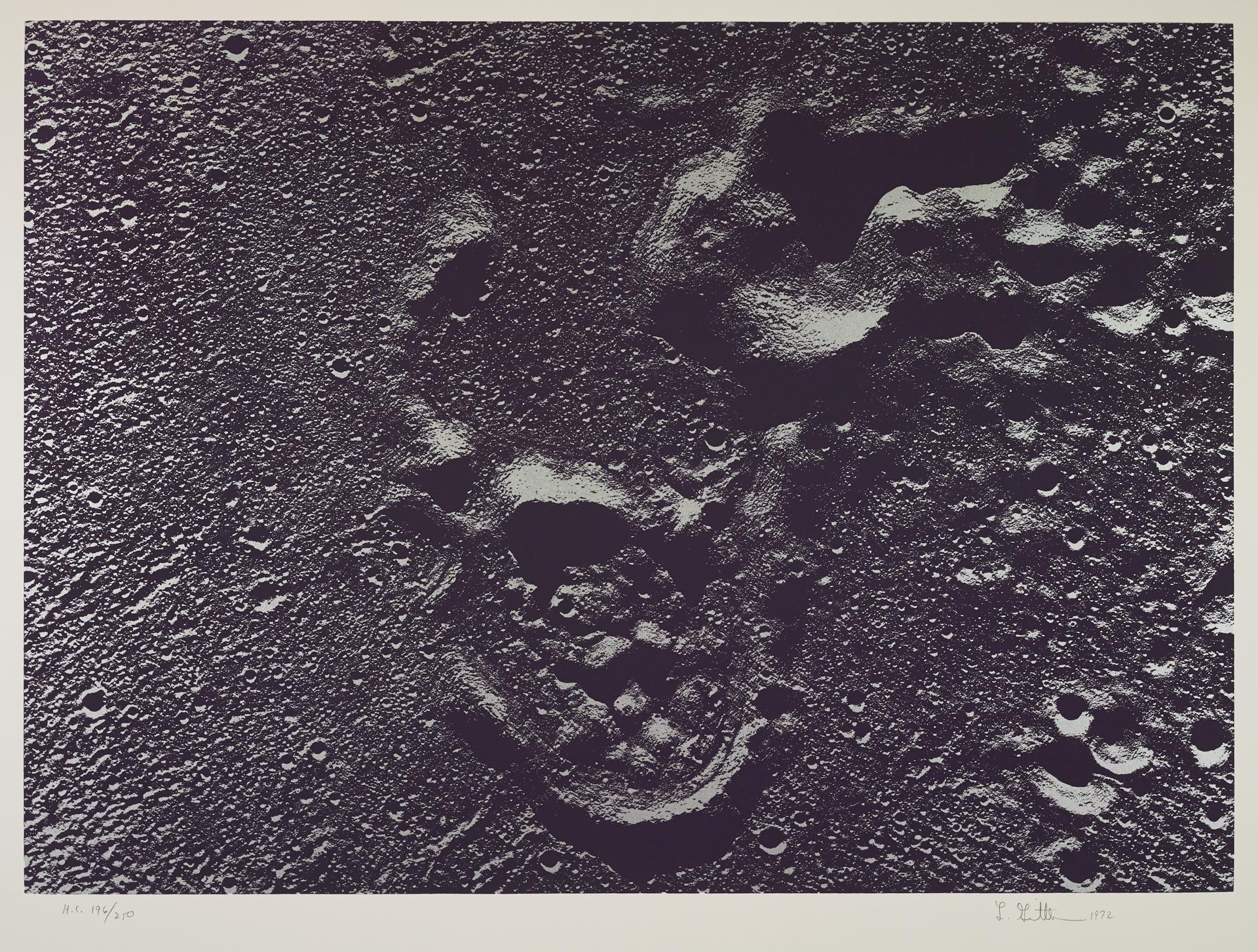
Printed on separate text page, TC: LUNAR FEATURES, Lunar Far Side, Perimeter of Van de Graaff, \ 23°S, 175°E. The five-mile-diameter crater at the bottom of the photograph was \ probably formed by volcanic action. This is determined by the height of the \ walls in relationship to the crater size. After the crater was formed, a molten \ lava flow formed the small, unnamed lava lake to the left. On the right hand \ side of the lake there are signs of subsidence where part of the molten lava \ flowed back into the moon's interior. The flow of lava deteriorated the crater \ walls and filled the crater. The hummocky appearance of the crater floor indi- \ cates that volcanic venting occurred after the mare was formed. \ The hills on the upper right may have been deposited or pushed up by \ the event that formed Van de Graaff crater. A second partially destroyed crater \ rim is also visible above the main crater. It is not uncommon to find two or more \ overlapping craters. They can be caused by the same or different processes. \ The large number of small craters in the area suggests that these events \ took place early in the moon's violent history. \ Robert J. Van de Graaff (1901-1967) was a Professor of Physics at M.I.T. \ who specialized in nuclear research.
Printed on separate text page, TC: LUNAR FEATURES, Lunar Far Side, Perimeter of Van de Graaff, \ 23°S, 175°E. The five-mile-diameter crater at the bottom of the photograph was \ probably formed by volcanic action. This is determined by the height of the \ walls in relationship to the crater size. After the crater was formed, a molten \ lava flow formed the small, unnamed lava lake to the left. On the right hand \ side of the lake there are signs of subsidence where part of the molten lava \ flowed back into the moon's interior. The flow of lava deteriorated the crater \ walls and filled the crater. The hummocky appearance of the crater floor indi- \ cates that volcanic venting occurred after the mare was formed. \ The hills on the upper right may have been deposited or pushed up by \ the event that formed Van de Graaff crater. A second partially destroyed crater \ rim is also visible above the main crater. It is not uncommon to find two or more \ overlapping craters. They can be caused by the same or different processes. \ The large number of small craters in the area suggests that these events \ took place early in the moon's violent history. \ Robert J. Van de Graaff (1901-1967) was a Professor of Physics at M.I.T. \ who specialized in nuclear research.
PortfolioItem