Unnamed Crater
Print
Unnamed Crater
1972
Screenprint
196/250
Image: 11 1/16 × 23 1/16 in. (28.1 × 58.5 cm)
Paper: 22 × 28 in. (55.9 × 71.1 cm)
Gift of ITEK Corporation
1973.0053.0008
Inscriptions Signed, dated, and editioned in pencil on recto, BC: H.C. 196/250 L.Gittleman 1972
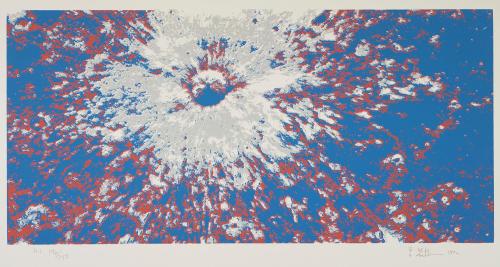
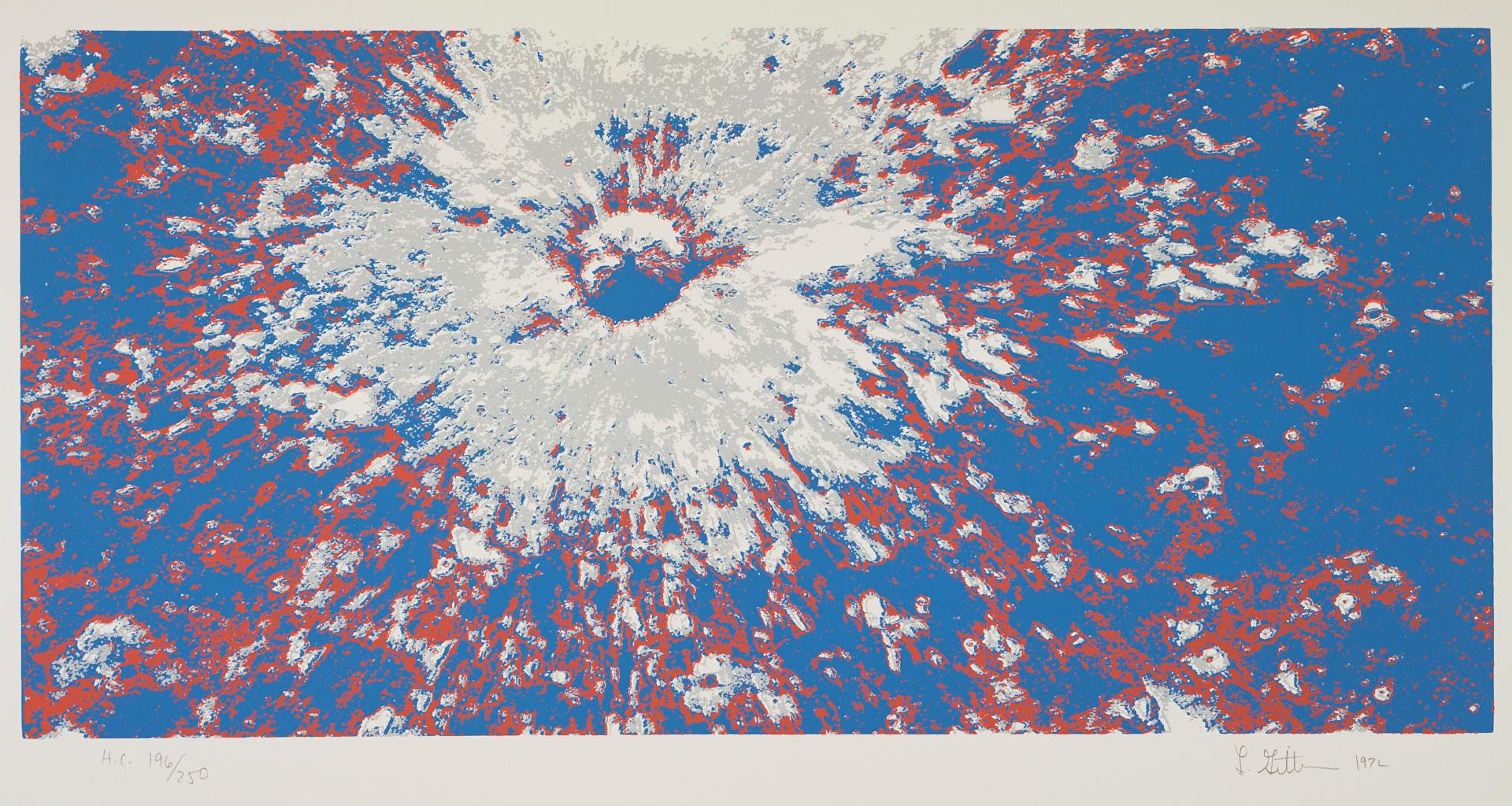
Printed on separate text page, TC: UNNAMED CRATER, Vicinity of Gagarin, 18°S, 145°E. Many large \ and small craters, believed to have been formed by the impact of meteorites \ or other extra-lunar projectiles, are characterized by systems of "rays" radiating \ from the center. The bright rays are thought to be subsurface materials ejected \ during the impact. Generally, the ejecta covers a band equal in width to the diameter of the crater from the rim of the crater and then thins. The impact \ of a large meteorite will throw out enough ejects to form sizable hills. The \ impacts of extremely large meteorites, such as that which formed Mare Imbrium, \ have pushed up mountain formations around the impact site due to the rebound \ of the moon's crust. \ For the past century, scientists have disagreed as to the origin of lunar \ craters – whether they were formed by volcanic action, by meteorite impact or \ by the collapse of the surface due to internal processes. After studying recent \ high resolution photography, it is now generally conceded that all three pro- \ cesses contributed to give the moon its pitted appearance. \ Yuri Gagarin, a Russian Cosmonaut, was the first man to orbit the earth \ on April 12, 1961.
Printed on separate text page, TC: UNNAMED CRATER, Vicinity of Gagarin, 18°S, 145°E. Many large \ and small craters, believed to have been formed by the impact of meteorites \ or other extra-lunar projectiles, are characterized by systems of "rays" radiating \ from the center. The bright rays are thought to be subsurface materials ejected \ during the impact. Generally, the ejecta covers a band equal in width to the diameter of the crater from the rim of the crater and then thins. The impact \ of a large meteorite will throw out enough ejects to form sizable hills. The \ impacts of extremely large meteorites, such as that which formed Mare Imbrium, \ have pushed up mountain formations around the impact site due to the rebound \ of the moon's crust. \ For the past century, scientists have disagreed as to the origin of lunar \ craters – whether they were formed by volcanic action, by meteorite impact or \ by the collapse of the surface due to internal processes. After studying recent \ high resolution photography, it is now generally conceded that all three pro- \ cesses contributed to give the moon its pitted appearance. \ Yuri Gagarin, a Russian Cosmonaut, was the first man to orbit the earth \ on April 12, 1961.
PortfolioItem