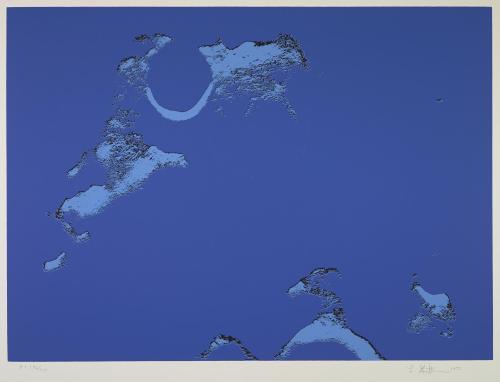
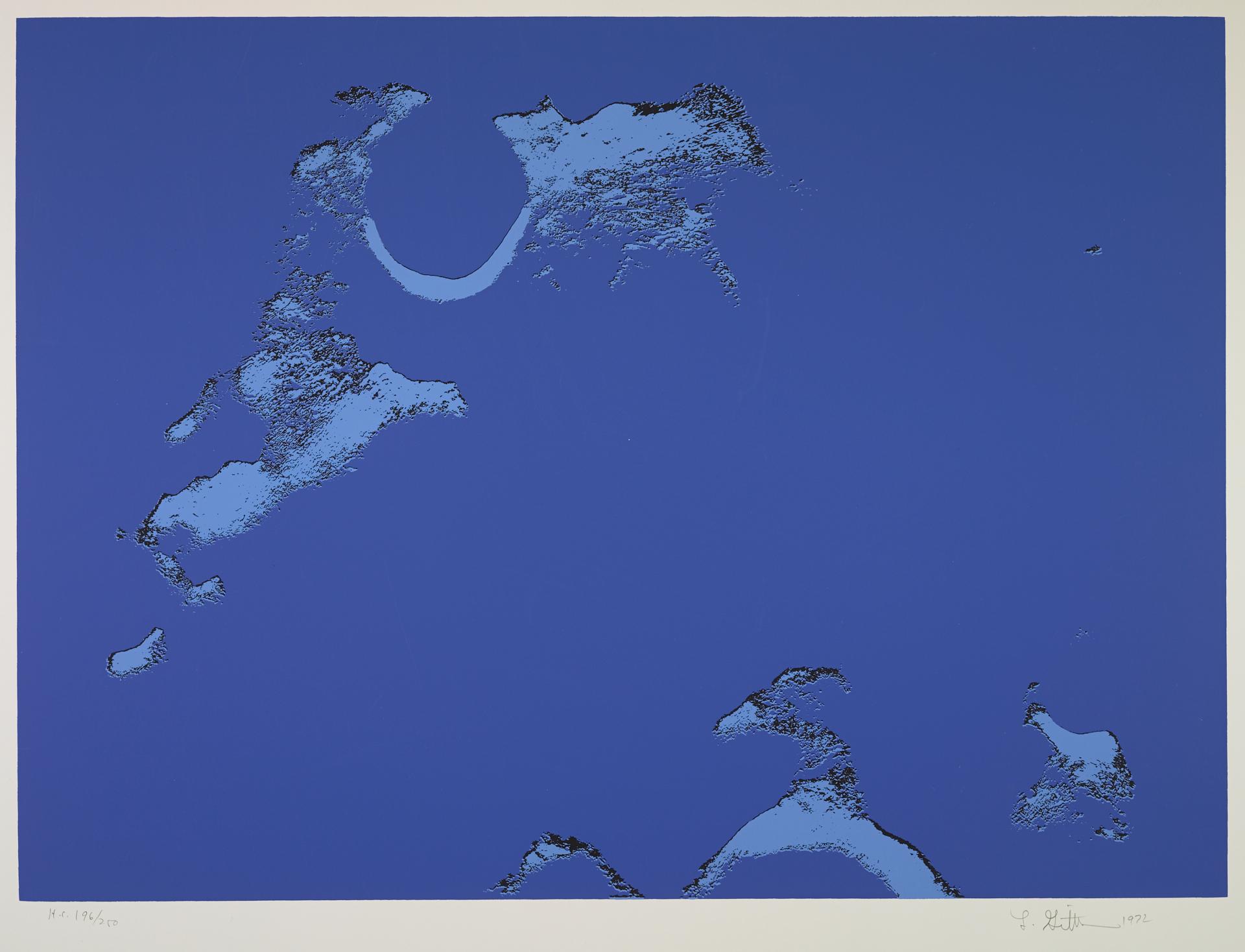
Area of Nassau
Print
Area of Nassau
1972
Screenprint
196/250
Image: 16 3/4 × 22 15/16 in. (42.6 × 58.2 cm)
Paper: 22 × 28 in. (55.9 × 71.1 cm)
Gift of ITEK Corporation
1973.0053.0010
Inscriptions Signed, dated, and editioned in pencil on recto, BC: H.C. 196/250 L.Gittleman 1972
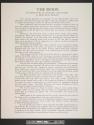
Printed on separate text page, TC: AREA OF NASSAU, Lunar Far Side, 25°S, 179°E. This was the second \ photograph taken by the Itek panoramic camera during the Apollo 15 mission. \ The sun was at an extremely low elevation – just a few degrees above the \ horizon. When this picture was taken, the terminator (the border between the \ illuminated and dark portions of the moon) was 12° to the west. \ Brilliant highlights and deep black shadows are typical of lunar photog- \ raphy and are caused by the absence of an atmosphere to diffuse or scatter \ sunlight and partially illuminate the shadows. Astronauts standing on the lunar \ surface cannot see detail in the shadows. \ The area is named for J.J. Nassau (1892-1965), an American astronomer \ noted for his studies of star spectra.
Printed on separate text page, TC: AREA OF NASSAU, Lunar Far Side, 25°S, 179°E. This was the second \ photograph taken by the Itek panoramic camera during the Apollo 15 mission. \ The sun was at an extremely low elevation – just a few degrees above the \ horizon. When this picture was taken, the terminator (the border between the \ illuminated and dark portions of the moon) was 12° to the west. \ Brilliant highlights and deep black shadows are typical of lunar photog- \ raphy and are caused by the absence of an atmosphere to diffuse or scatter \ sunlight and partially illuminate the shadows. Astronauts standing on the lunar \ surface cannot see detail in the shadows. \ The area is named for J.J. Nassau (1892-1965), an American astronomer \ noted for his studies of star spectra.
PortfolioItem