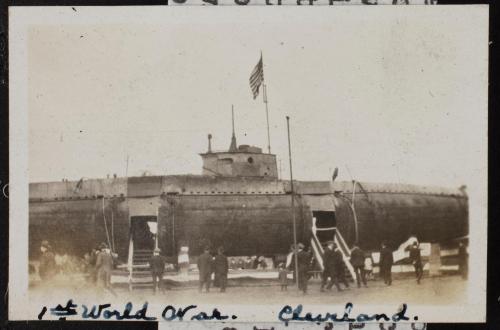
[People standing in front of a World War I submarine]
Photograph
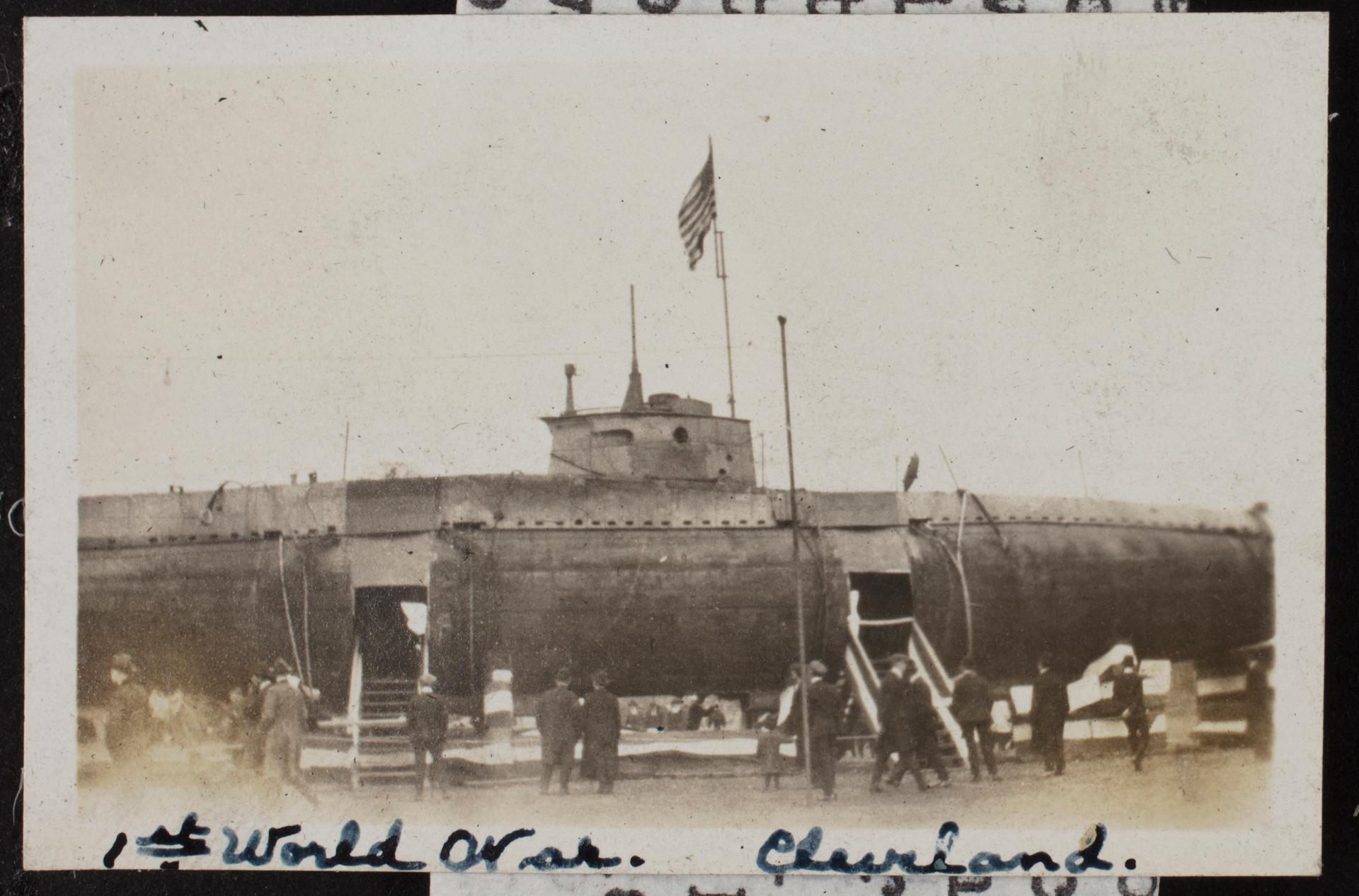
[People standing in front of a World War I submarine]
From the album [Snapshots from travels in the United States and Canada]
ca. 1930
Gelatin silver prints
Overall: 1 5/8 × 2 5/8 in. (4.2 × 6.6 cm)
Gift of the 3M Foundation, ex-collection Louis Walton Sipley, 1977
1978.1292.0091h
Inscriptions Written in ink on recto, BC: 1st World War. Cleveland.
Typed in ink on slip of paper placed behind photograph: Submarine of World War I on exhibition at about the foot of Ninth Street, Cleveland, Ohio, inside the breakwater on Lake Erie. Taken by someone about 1917 or 1918. A. Thomas Nelson probably printed for a friend and saved a print for Mrs. Nelson. Ladies should have been glad for the opportunity to go aboard as ordinarily they were not permitted on submarines.
I recall passing four at the Philadelphia Navy Yard with Chief Boarswain and Mrs. Sabelstrom early in 1909. He being an officer got permission to take me aboard. I had to go down a slender metal perpendicular ladder through a small hole. They were the first type and very close quarters inside. I recall looking through the pyrascope. All was a rare treat, "something to write home about". Chief Boatswaih Sabelstrom being Swedish could not enter Annapolis. He had served in the Swedish Navy, and thus, not an Annapolis graduate had attained the highest rank possible. Gus Sabelstrom and his wife lie burried [sic] in Arlington Semetery [sic] near Washington, D.C.
As long as Philadelphia was home base (the Prairie) Mrs. Sabelstrom remained here and we went to the Navy Yard frequently. The marines were always drilling and we would dash from one parade ground to another. I was Miss Price, Catherine to another. I was Miss Price, Catherine (Kathryn) H. Price at that time though I knew Mr. Nelson well. It was a difficult ordeal and touching sight to see the Prarie [sic] leave, with bands playing, the ship going slowly out to the river while all the men were waving goodby [sic]: so we only saw her off once. When Mr. Sabelstrom was "in" he stayed ashore at Mrs. Sabelstrom's room when possible, coming off duty at night and returning in the morning. The men were always glad to get ashore. Mrs. Sabelstrom and I dined in the officers quarters on the Prairie: he also took us in the officers quarters of other ships and battle ships about which I learned much: the ship's silver service being presented by the state for which the ship was named, etc. There is always an "officer of the day" at the gang plank, or near, and when wishing to be shown about, one should approach and request the officer of the day and they will literally almost stand on their heads to designate someone to show people about. One gets to see everything that can be shown. I had many privileges, knowing an officer, Mr. Burke also, that I would not otherwise have had. Several years after Mr. Nelson and I were married we saw a notice in the paper of the old Prairie, not even a battleship, having taken successful action with her guns. (Was it during a Mexican conflagration?) Anyway she came out with flying colors and one ship was all that was needed.
Mr. Sabelstrom had once given me a black cap ribbon with "Prairie" woven in gold and a red, white and blue cap ribbon which he inscribed and signed, as souvenirs and which I prized much.
After Mr. Sabelstrom was retired they built a home in Washington, D.C. at 2924 Carlton Ave., N.E. It was too large and there were too many windows so they built again. I recall being invited to visit "even though the cellar is just being dug". They were so anxious to get settled and have their friends. I never saw the inside of the house for they soon built a smaller place in sight of this one which stood at the end of the street. They built in Woodridge at 3121. I visited them at this place many times. Their fine neighbor on their left did scientific work and seems to me was connected with the National Geographic. Mr. Sabelstrom had a back yard which ran through to the next street and one could see a nearby woods in that direction. As the back yard was hilly he had a rock garden and was very fond of raising flowers. He of course had a great big flag pole and flag in the front yard, which flag was put up and taken down at the proper time to the second.
When at the Philadelphia Navy Yard with Mrs. Sabelstrom it was always interesting to see the ships anchored along the Delaware River but in the Navy Yard, salute the foreign vessels as they came along, by dipping their flags at the stern. Traffic on the Delaware was continuous and fast so that as a ship came along, each in the Navy Yard on the shore line would dip their flag, then the foreign ship would respond in like manner. It seemed that as one watched down the line, it was almost a slow wave of dipping at times.
Typed in ink on slip of paper placed behind photograph: Submarine of World War I on exhibition at about the foot of Ninth Street, Cleveland, Ohio, inside the breakwater on Lake Erie. Taken by someone about 1917 or 1918. A. Thomas Nelson probably printed for a friend and saved a print for Mrs. Nelson. Ladies should have been glad for the opportunity to go aboard as ordinarily they were not permitted on submarines.
I recall passing four at the Philadelphia Navy Yard with Chief Boarswain and Mrs. Sabelstrom early in 1909. He being an officer got permission to take me aboard. I had to go down a slender metal perpendicular ladder through a small hole. They were the first type and very close quarters inside. I recall looking through the pyrascope. All was a rare treat, "something to write home about". Chief Boatswaih Sabelstrom being Swedish could not enter Annapolis. He had served in the Swedish Navy, and thus, not an Annapolis graduate had attained the highest rank possible. Gus Sabelstrom and his wife lie burried [sic] in Arlington Semetery [sic] near Washington, D.C.
As long as Philadelphia was home base (the Prairie) Mrs. Sabelstrom remained here and we went to the Navy Yard frequently. The marines were always drilling and we would dash from one parade ground to another. I was Miss Price, Catherine to another. I was Miss Price, Catherine (Kathryn) H. Price at that time though I knew Mr. Nelson well. It was a difficult ordeal and touching sight to see the Prarie [sic] leave, with bands playing, the ship going slowly out to the river while all the men were waving goodby [sic]: so we only saw her off once. When Mr. Sabelstrom was "in" he stayed ashore at Mrs. Sabelstrom's room when possible, coming off duty at night and returning in the morning. The men were always glad to get ashore. Mrs. Sabelstrom and I dined in the officers quarters on the Prairie: he also took us in the officers quarters of other ships and battle ships about which I learned much: the ship's silver service being presented by the state for which the ship was named, etc. There is always an "officer of the day" at the gang plank, or near, and when wishing to be shown about, one should approach and request the officer of the day and they will literally almost stand on their heads to designate someone to show people about. One gets to see everything that can be shown. I had many privileges, knowing an officer, Mr. Burke also, that I would not otherwise have had. Several years after Mr. Nelson and I were married we saw a notice in the paper of the old Prairie, not even a battleship, having taken successful action with her guns. (Was it during a Mexican conflagration?) Anyway she came out with flying colors and one ship was all that was needed.
Mr. Sabelstrom had once given me a black cap ribbon with "Prairie" woven in gold and a red, white and blue cap ribbon which he inscribed and signed, as souvenirs and which I prized much.
After Mr. Sabelstrom was retired they built a home in Washington, D.C. at 2924 Carlton Ave., N.E. It was too large and there were too many windows so they built again. I recall being invited to visit "even though the cellar is just being dug". They were so anxious to get settled and have their friends. I never saw the inside of the house for they soon built a smaller place in sight of this one which stood at the end of the street. They built in Woodridge at 3121. I visited them at this place many times. Their fine neighbor on their left did scientific work and seems to me was connected with the National Geographic. Mr. Sabelstrom had a back yard which ran through to the next street and one could see a nearby woods in that direction. As the back yard was hilly he had a rock garden and was very fond of raising flowers. He of course had a great big flag pole and flag in the front yard, which flag was put up and taken down at the proper time to the second.
When at the Philadelphia Navy Yard with Mrs. Sabelstrom it was always interesting to see the ships anchored along the Delaware River but in the Navy Yard, salute the foreign vessels as they came along, by dipping their flags at the stern. Traffic on the Delaware was continuous and fast so that as a ship came along, each in the Navy Yard on the shore line would dip their flag, then the foreign ship would respond in like manner. It seemed that as one watched down the line, it was almost a slow wave of dipping at times.
Album-PageItem