Oceanus Procellarum
Print
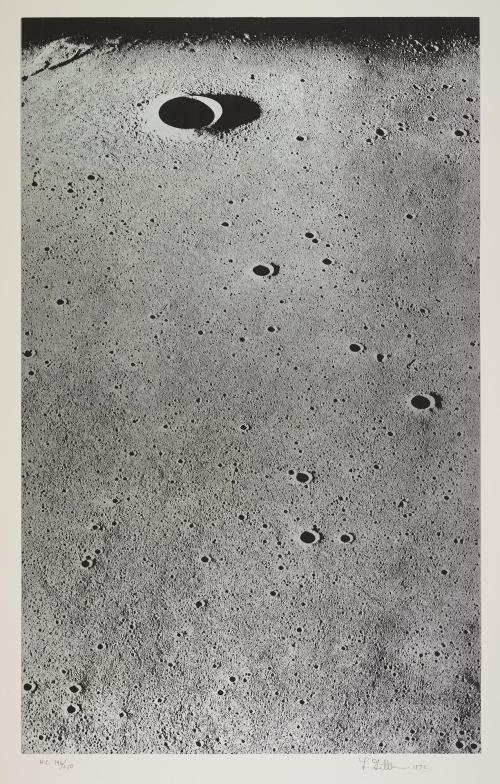
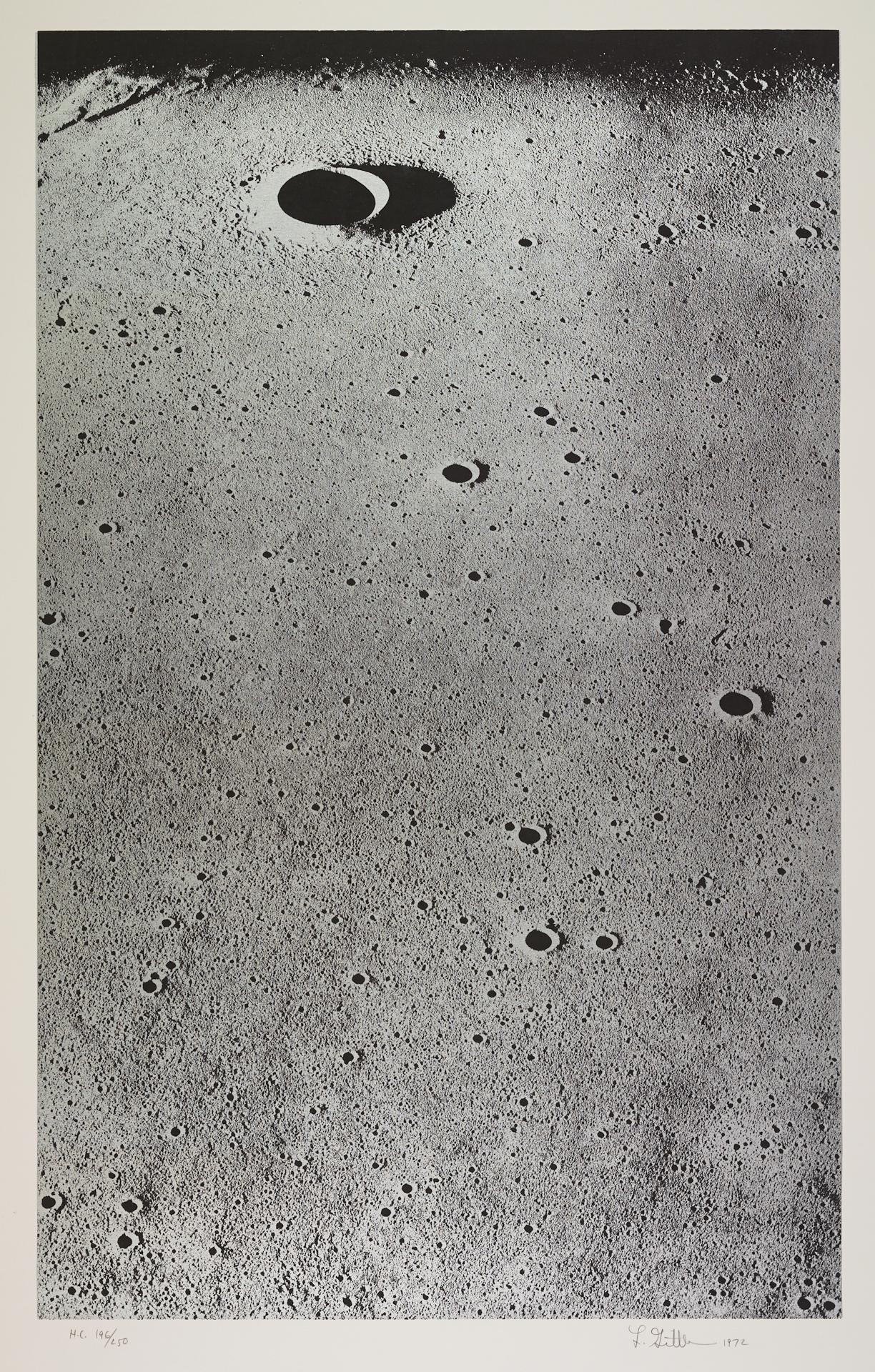
Oceanus Procellarum
1972
Screenprint
196/250
Image: 23 1/16 × 14 3/8 in. (58.5 × 36.5 cm)
Paper: 28 × 22 in. (71.1 × 55.9 cm)
Gift of ITEK Corporation
1973.0053.0001
Inscriptions Signed, dated, and editioned in pencil on recto, BC: H.C. 196/250 L.Gittleman 1972
Printed on separate text page, TC: OCEANUS PROCELLARUM (Ocean of Storms) 34°N, 60°W. This \ strinkingly barren scene is in Oceanus Procellarum and is typical of the vast \ expanses of many lunar maria. The floor of Oceanus Procellarum is believed to \ be formed of lava ranging from a few hundred yards to more than half a mile \ thick. It was created when the temperature beneath the lunar surface became \ high enough (2,400°F) to melt rock. This melted rock then flooded the area. \ The large number of craters in the area indicate that Oceanus Procellarum was \ formed early in the moon's 4.6-billion-year history. It is the largest lunar mare, \ with an area of about two million square miles. \ Maria were formed either by the flow of lava, as Oceanus Procellarum, or \ by the impact of large meteors, as in the cases of Mare Serenitatis and Mare \ Imbrium. Mare Imbrium, for example, was believed to have been formed by \ a 50-mile-diameter meteroite which dug out a 650-mile-wide basin. The impact- \ created maria were flooded with lava at some time after they were formed.
Printed on separate text page, TC: OCEANUS PROCELLARUM (Ocean of Storms) 34°N, 60°W. This \ strinkingly barren scene is in Oceanus Procellarum and is typical of the vast \ expanses of many lunar maria. The floor of Oceanus Procellarum is believed to \ be formed of lava ranging from a few hundred yards to more than half a mile \ thick. It was created when the temperature beneath the lunar surface became \ high enough (2,400°F) to melt rock. This melted rock then flooded the area. \ The large number of craters in the area indicate that Oceanus Procellarum was \ formed early in the moon's 4.6-billion-year history. It is the largest lunar mare, \ with an area of about two million square miles. \ Maria were formed either by the flow of lava, as Oceanus Procellarum, or \ by the impact of large meteors, as in the cases of Mare Serenitatis and Mare \ Imbrium. Mare Imbrium, for example, was believed to have been formed by \ a 50-mile-diameter meteroite which dug out a 650-mile-wide basin. The impact- \ created maria were flooded with lava at some time after they were formed.
PortfolioItem