[Man (uncut sheet of cartes de visite)]

Photograph
[Man (uncut sheet of cartes de visite)]
ca. 1860
Albumen silver print
Image (each): 3 3/4 × 2 5/16 in. (9.5 × 5.8 cm)
Overall: 7 11/16 × 9 5/16 in. (19.5 × 23.7 cm)
Mount: 8 3/4 × 10 5/16 in. (22.2 × 26.2 cm)
Gift of Alden Scott Boyer
1981.2244.0002
Inscriptions Inscribed in pencil on verso, TR: Disdéri: uncut sheet of carte-de-visite \ portraits of a gentleman.
Inscribed in pencil on verso, BC: 9 [or 6, circled]
Inscribed in pencil on verso, BC: 9 [or 6, circled]
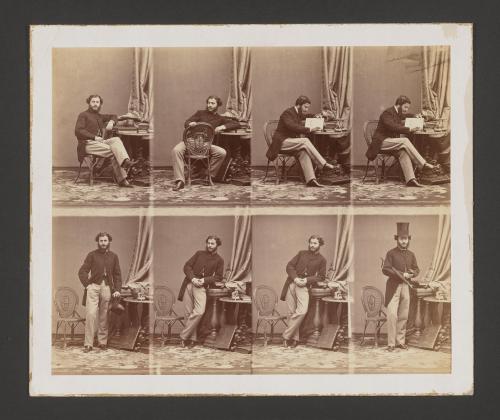
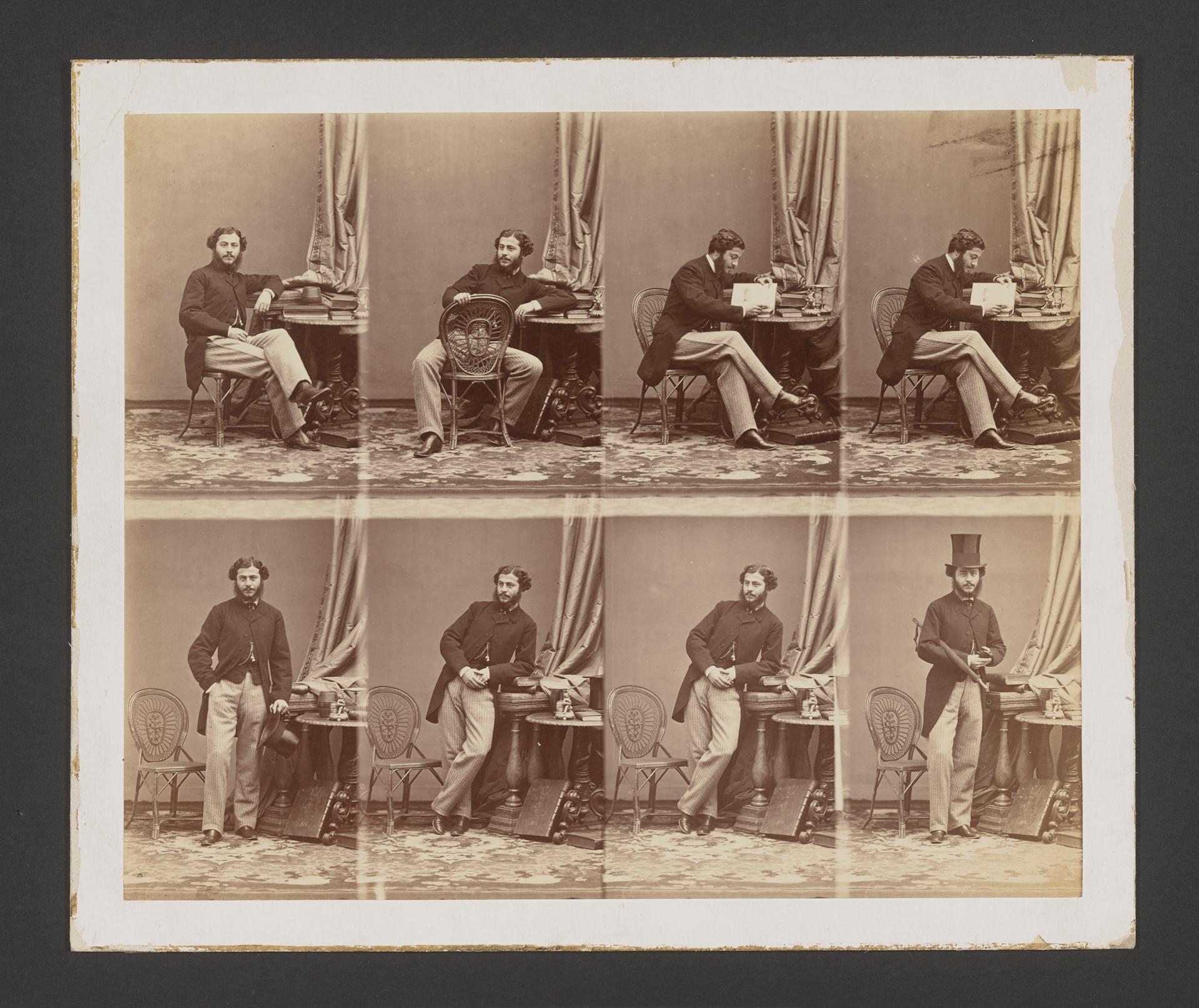
TextThe introduction of wet-plate collodion negatives and albumen silver prints revolutionized the practice of portrait photography. The relatively brief exposure times they required and the ability to make multiple prints from a single negative were a boon to the growing number of photography studios. Furthermore, in 1853, when André-Adolphe-Eugène Disdéri patented a camera that could record eight individual images on the same glass negative, the economics of photographic production changed. Once the negative was printed, workers cut the sheets into individual small prints and mounted them on standard-sized cards, producing eight photographs in little more than the time it typically took to make a single photographic portrait. Customers traded the cards, imprinted with the studio’s logo, and often stored them in albums designed to hold cartes de visite, the term Disdéri used when he patented the format in 1854. (This uncut sheet is a rarity.)
Sometimes all eight frames contained the same image, but at other times sitters varied their posture—as here, where a man strikes a number of poses ranging from the conventional to the casual. Cartes de visite of well-known personalities became very popular, as indicated by the four on the right, all of which depict Empress Eugènie (French, b. Spain, 1826–1920), wife of Napoleon III. Known for her beauty, glamour, charm, and intelligence, she was a trendsetter, the nineteenth-century equivalent of today’s international celebrity.
Lisa Hostetler, Ph.D.
Curator in Charge, Department of Photography
Label for A History of Photography [Rotation 1]
May 9–September 28, 2014
Sometimes all eight frames contained the same image, but at other times sitters varied their posture—as here, where a man strikes a number of poses ranging from the conventional to the casual. Cartes de visite of well-known personalities became very popular, as indicated by the four on the right, all of which depict Empress Eugènie (French, b. Spain, 1826–1920), wife of Napoleon III. Known for her beauty, glamour, charm, and intelligence, she was a trendsetter, the nineteenth-century equivalent of today’s international celebrity.
Lisa Hostetler, Ph.D.
Curator in Charge, Department of Photography
Label for A History of Photography [Rotation 1]
May 9–September 28, 2014