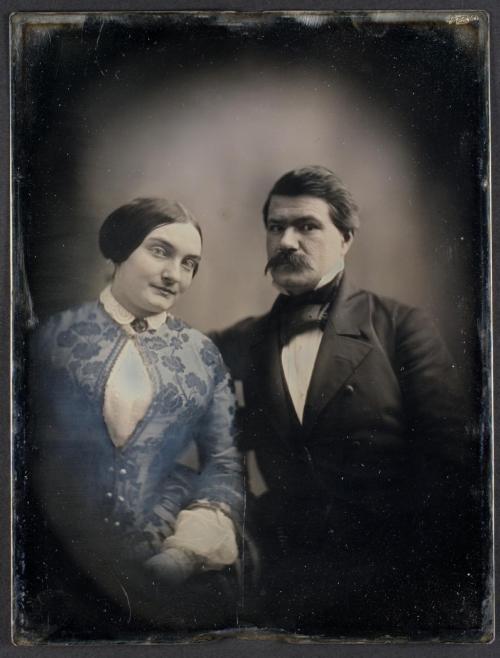
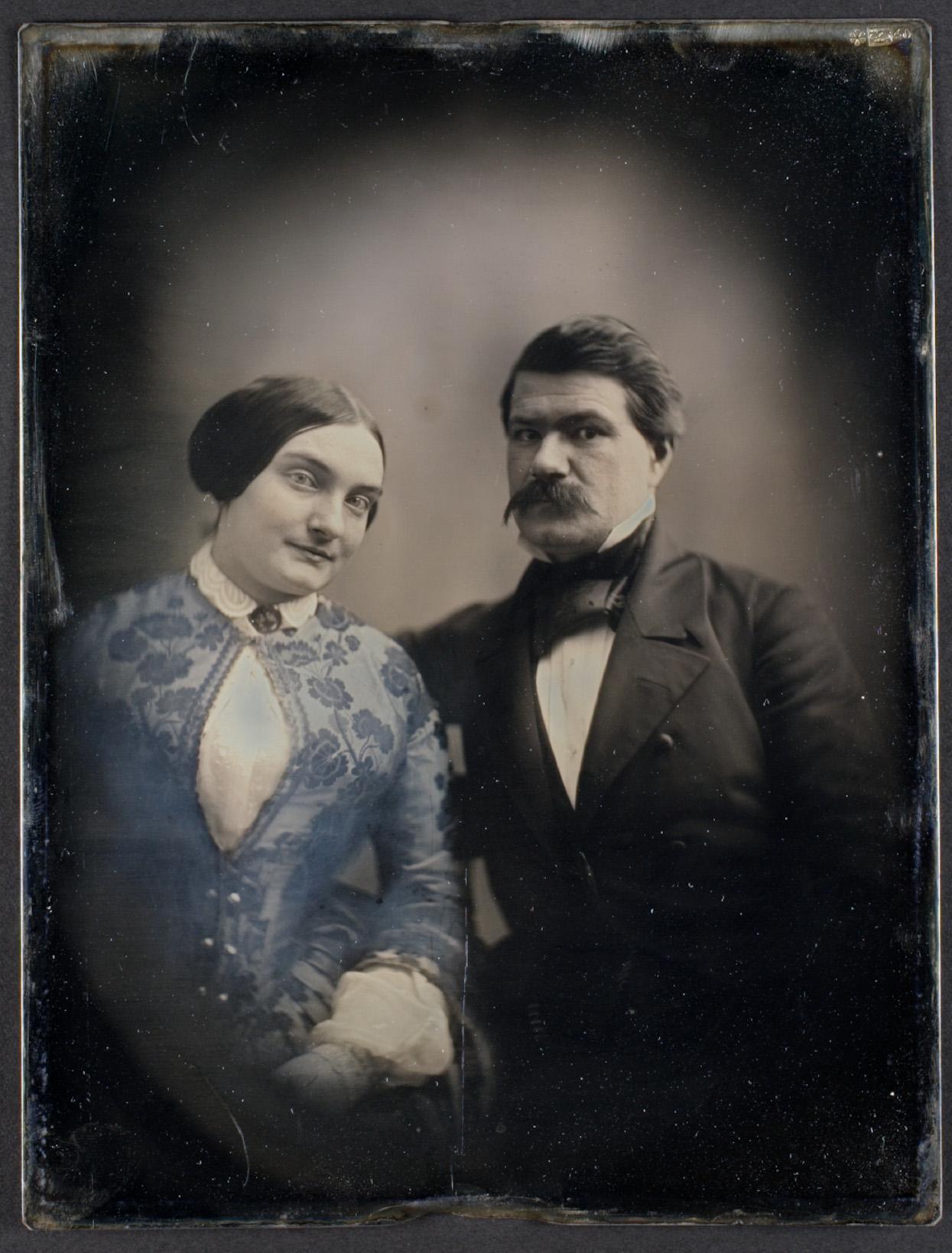
[Woman and man]
Photograph
Southworth & Hawes
Maker
Albert Sands Southworth, American, 1811–1894; Josiah Johnson Hawes, American, 1808–1901
[Woman and man]
ca. 1850
Daguerreotype with applied color
Image (whole plate): 8 7/16 × 6 1/2 in. (21.5 × 16.5 cm)
Gift of Alden Scott Boyer
1974.0193.0009
Inscriptions Hallmark on recto, TRC: DOUBLE \ J P 40 [see The Daguerreotypes of Southworth & Hawes (Sobieszek and Appel, 1980) #9, p. 113]
Inscribed in pencil on previous backing board, verso: [circled] "73" "new backing & mat spacer resealed 6-22-89" "EZ"
Inscribed in pencil on previous backing board, verso: [circled] "73" "new backing & mat spacer resealed 6-22-89" "EZ"
Text
From their studio on Tremont Row, the Boston partnership of Southworth & Hawes produced some of the most compelling daguerreotypes known today. Their subjects ranged from prominent nineteenth-century Americans, including Daniel Webster, Harriet Beecher Stowe, and Ralph Waldo Emerson, to members of the early American upper and middle classes. In their writings and advertisements, they emphasized their artistic approach to portraiture. Priding themselves on a “soft” look, they quickly distinguished themselves from the majority of their peers, whose portraits tended to exhibit harsher details and stiffer, relatively generic poses.
This daguerreotype demonstrates Southworth & Hawes’s skill at capturing expressions and poses that seem natural and characteristic of the sitters. Despite the fact that the identity of the sitters remains unknown, the apparent charisma of the woman—who gazes at the camera with a charming mix of skepticism and curiosity—and the man’s visible reserve give the viewer the impression of knowing something about who they were in addition to how they looked.
Lisa Hostetler, Ph.D.
Curator in Charge, Department of Photography
Label for A History of Photography [Rotation 1]
May 9–September 28, 2014
From their studio on Tremont Row, the Boston partnership of Southworth & Hawes produced some of the most compelling daguerreotypes known today. Their subjects ranged from prominent nineteenth-century Americans, including Daniel Webster, Harriet Beecher Stowe, and Ralph Waldo Emerson, to members of the early American upper and middle classes. In their writings and advertisements, they emphasized their artistic approach to portraiture. Priding themselves on a “soft” look, they quickly distinguished themselves from the majority of their peers, whose portraits tended to exhibit harsher details and stiffer, relatively generic poses.
This daguerreotype demonstrates Southworth & Hawes’s skill at capturing expressions and poses that seem natural and characteristic of the sitters. Despite the fact that the identity of the sitters remains unknown, the apparent charisma of the woman—who gazes at the camera with a charming mix of skepticism and curiosity—and the man’s visible reserve give the viewer the impression of knowing something about who they were in addition to how they looked.
Lisa Hostetler, Ph.D.
Curator in Charge, Department of Photography
Label for A History of Photography [Rotation 1]
May 9–September 28, 2014