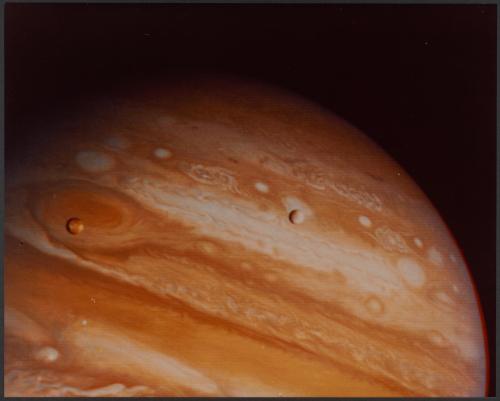
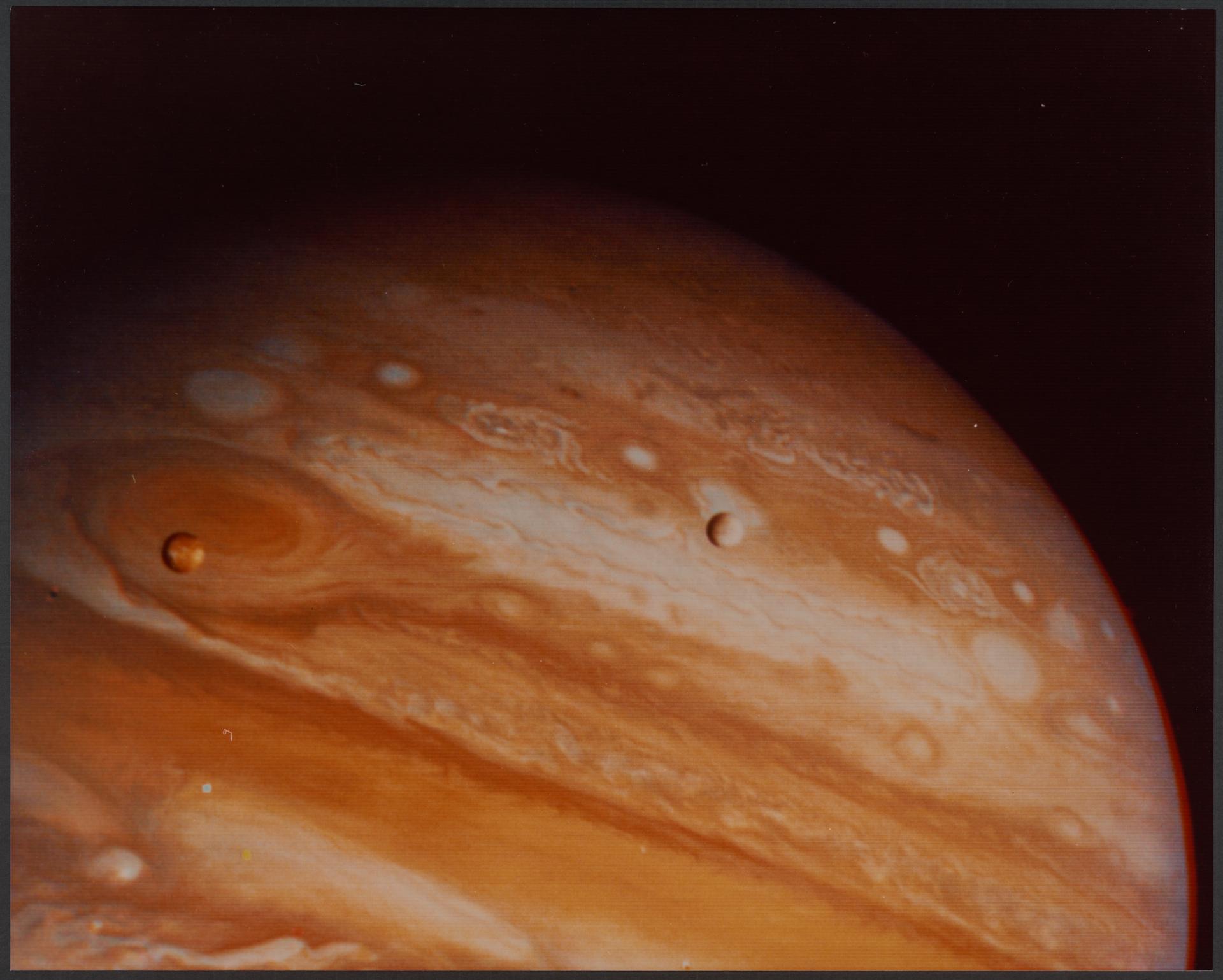
Jupiter with Satellites Io and Europa

Photograph
Jupiter with Satellites Io and Europa
February 13, 1979
Chromogenic development print
Overall: 15 15/16 × 19 15/16 in. (40.5 × 50.7 cm)
Gift of NASA and NASA Jet Propulsion Laboratory
Inscriptions verso (applied label, typed): PUBLIC INFORMATION OFFICE/ JET PROPULSION LABORATORY/ CALIFORNIA INSTITUTE OF TECHNOLOGY/ NATIONAL AERONAUTICS AND SPACE ADMINISTRATION/ PASADENA, CALIFORNIA, 91109. TELEPHONE: (213) 354-5011/ P-21082 C/ 1-19/ 2/21/79/ Voyager 1 took this photo of Jupiter and two of its satellites/ (Io, left, and Europa) on Feb. 13, 1979. Io is about 350,000/ kilometers (220,000 miles) above Jupiter's Great Red Spot;/ Europa is about 600,000 kilometers (375,000 miles) above Jupiter's/ clouds. Although both satellites have about the same brightness,/ Io's color is very different from Europa's. Io's equatorial/ region show two types of material -- dark orange, broken by/ several bright spots -- producing a mottled appearance. The/ poles are darker and reddish. Preliminary evidence suggests/ color variations within and between the polar regions. Io's/ surface composition is unknown, but scientists believe it may/ be a mixture of salts and sulfur. Europa is less strongly/ colored, although still relatively dark at short wavelengths./ Markings on Europa are less evident than on the other satellites,/ although this picture shows darker regions toward the trailing/ half of the visible disk. Jupiter is about 20 million kilo-/ meters (12.4 million miles) from the spacecraft. At this reso-/ lution (about 400 kilometers or 250 miles) there is evidence/ of circular motion in Jupiter's atmosphere. While the dominant/ large-scale motions are west-to-east, small-scale movement/ includes eddy-like circulation within and between the bands./ This photo was assembled from three black and white negatives/ by the Image Processing Lab at Jet Propulsion Laboratory. JPL/ manages and controls the Voyager project for NASA's Office of/ Space Science.