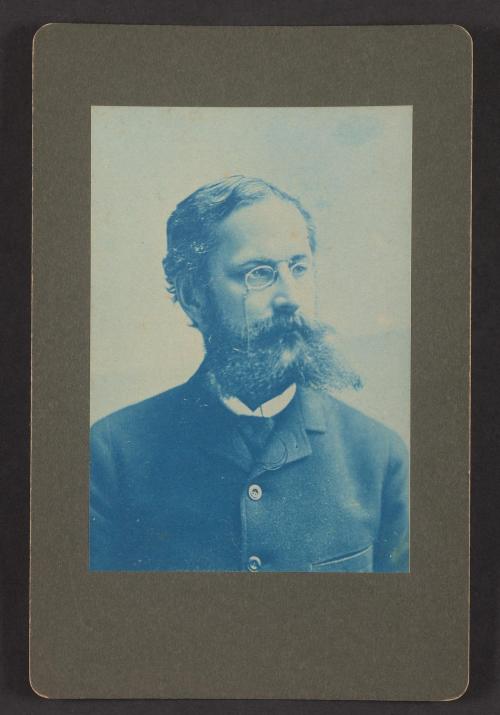
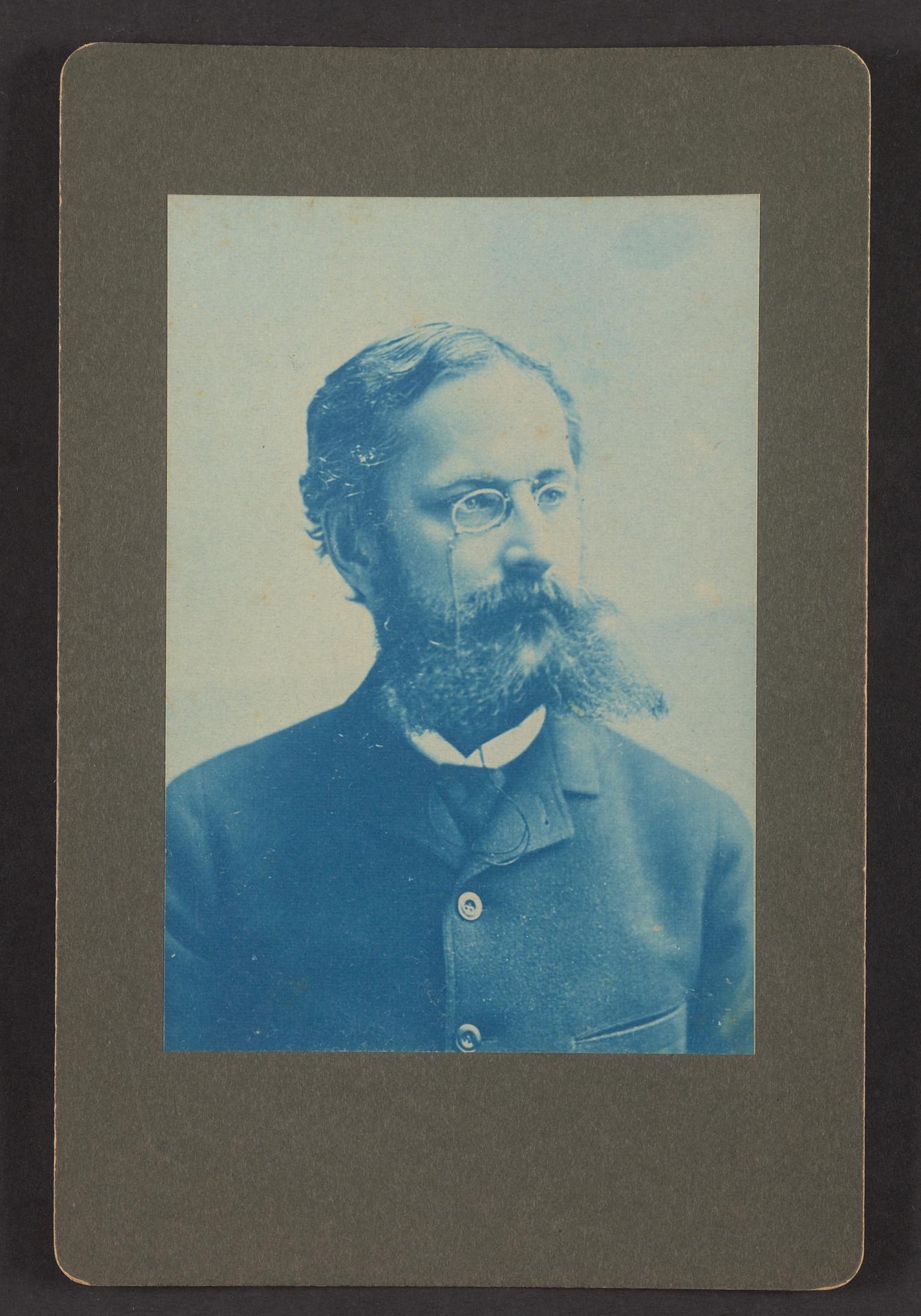
Adolphus Washington Greely
Photograph
Unidentified
Maker
Adolphus Washington Greely
From Sketches of Heroes of the American Army and Navy to Accompany The Journal's Photographs in Blue
ca. 1900
Cyanotype
Image: 11.4 x 7.8 cm
Mount: 16.5 x 10.7 cm
Gift of Donald K. Weber, 2009
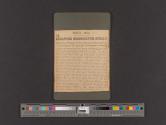
Inscriptions verso (printed in black on applied newsprint): NO. 30. / ADOLPHUS WASHINGTON GREELY. / (Sketches of Heroes of the American Army and Navy / to Accompany The Journal's Photographs in Blue.) / Adolphus Washington Greely was born in Newburyport, Mass., March / 27, 1844. He was educated at Brown high school in 1860 and enlisted / in the Ninetenth [sic] Massachusetts regiment July 3, 1861. He was pro- / moted until, on March 13, 1865, he was brevetted major of volunteers for / faithful services during the civil war. Soon after, he was detailed for / duty in the signal service, and in 1881, was selected to command the ex- / pedition sent into the Arctic regions to establish one of thirteen circum- / polar stations for scientific purposes. His party, twenty-five in all, / sailed from St. John's, Newfoundland, in the Proteus on July 7, 1881. / He reached Discovery harbor and remained there two years. Two re- / lief expeditions that had been sent out failed to reach Discovery harbor. / On August 9, 1883, Greely and his party set out on their retreat southward. / On October 15, after meeting with various adventures, and being com- / pelled to abandon their steam launch in the ice, they reached they reached Cape Sa- / bine, where they established their winter quarters. Here they suffered / greatly from want of food. Sixteen of the party died from starvation, / one was drowned, and one, Private Henry, was shot by Greely's orders, / on the ground that he repeatedly stole food. The seven survivors were / rescued by the thirdrelief expedition under Capt. Winfield S. Schley, on / June 22, 1883, in so exhausted a condition that forty-eight hours' delay / would have been fatal. He was promoted to captain, June 11, 1886, and in / 1887 after the death of Gen. William B. Hazen, was appointed by Presi- / dent Cleveland to succeed that officer as chief of the signal service corps, / with the rank of brigadier general. In 1885, he was given the Queen's gold / medal by the Royal Geographic society, and he also received a gold / medal from the Paris Geographical society. He published "Three / Years of Arctic Service"(New York, 1886.) During the recent war he / has rendered valuable service as chief of the signal service.